Paint marking a Timber Rattlesnake

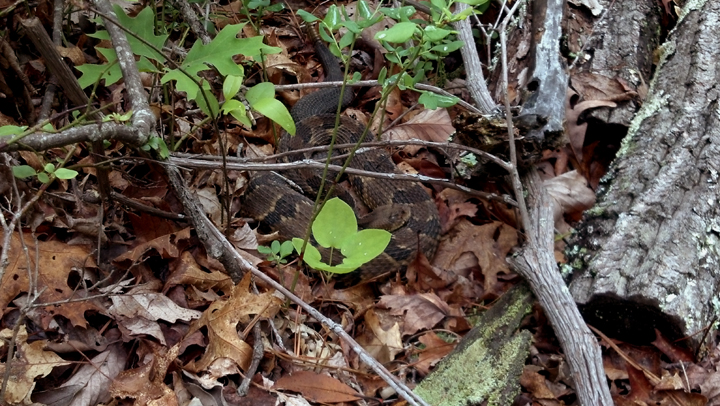
A few days ago we discovered a new Timber Rattlesnake near Earthshine.  It is a healthy dark phase female with a rather large rattle string. Fortunately she was found in the same are where Utsanati was found a little over a year ago. This area is visited only occasionally by lodge staff members and never by guests.  I captured and relocated the snake to a location a short distance away from the capture site.  Hopefully the snake will remember being captured and not return to the site.  In order to know if the snake returns I have paint marked three lower segments of its rattle with red acrylic paint so that if the snake returns or is ever seen again we will be able to visually ID it from a safe distance. If the snake is seen frequently, its movements, and eventually its home range can be plotted on a map.

Watch the video of the paint marking and release below.

Rattlesnake Report for 7/1/12

Rattlesnake Report for 7/1/2012.  In these special blog postings I will update you on the movements and status of the Timber Rattlesnakes Utsanati and Zoe that we are following with radio telemetry.  I have come up with a “potential danger level” scale that represents the potential danger the snakes could pose to the human inhabitants of the community due to their proximity to human habitations and activity areas.  The danger level also applies to the snakes being in danger if they are near a road or yard where they could be accidentally injured or killed or injured by man and his machines and toxic chemicals such as insecticides and herbicides.  If you live in the community where the snakes live please pay close attention to their locations and the “potential danger level” and take appropriate care in your activities to protect you and the snakes from any harm.  The scale will be as follows: Danger Level 1= No immediate danger.  The snake is in the rough.  Danger Level 5=High danger level.  The snake is very close to a residence/trail/road–walk, drive or mow carefully and please do not spray toxic chemicals in the area where the snake was last found.  If you have questions about the snake’s locations please do not hesitate to contact me.

It has been about one month since I reported on the snakes so I will recap their status since that time.

On June 09, 2012, I had to remove Utsanati–the male rattlesnake–from a woodpile where he was sheltering because the woodpile was going to be demolished.  After he was taken into captivity I decided to have him x-rayed to check the status of his transmitters antenna.  I did this because the strength of his transmitter’s signal had been dropping over the last few weeks reducing the range in which I could track him so I was afraid that I might loos track of him if the battery was getting low or the antenna was having a problem.  The xray showed that the antenna had come loose from its forward attachment point and had and retracted backward causing a loss of signal.  This will have to be repaired in a minor surgery before Utsanati can be released back into his habitat.   I will be sure to post a video of the surgery here for you to view as soon as it is complete and Utsanati is back in the wild.  In the meantime I have Utsanati in captivity where he has eaten two mice and one small rabbit that was killed by a pet cat.  Utsanati’s danger level is a 0.

Zoe, the female rattlesnake is still in the vicinity of the waterfall and deep in the forest and she seems to be slowly making her way back up along the ridgeline.   She is close to an area that seems to be rarely  used as a walking trail so her danger level is a 1.

Watch the video below for Utsanati’s capture from the woodpile and x-ray procedure and Zoe’s previous two locations.
http://www.youtube.com/watch?v=-Lux6ls3Ro8

Rattlesnake Report for 6/4/12

I tracked Zoe on 6/3/12. She remains in the same area of old fields and tangled undergrowth as I reported on 5/28. She has only moved around 50 feet and was in a tight resting coil when I found her. While searching for her I “discovered” a beautiful waterfall known as Kings falls.

Watch the video below for the full report.

Rattlesnake Report for 5/28/12

Today when i went to look for Zoe I was unable to get a signal in any direction. I walked deeper into the forest and still no signal. I drove to the end of the road–no signal. I began to think she had either moved out of range or been carried off by a predator such as a hawk or owl. i decided to search for Utsanati’s signal to see if he had moved closer to Zoe and when I input his frequency into the receiver his signal was as if he was sitting right next to me! I panned the antenna around just to be sure and yes–he was right in front of me in the very same woodpile that he visited in the late summer of 2011. He had come back to the woodpile for what purpose–rodents, thermoregulation, shelter–or all of the above. Whatever the purpose I quickly got some video and data and left him alone in all his glory. I am amazed that in one week he has moved so far. He trekked from the top of the mountain above Earthshine to the woodpile–moving most likely along the edge of the forest as he did last year after his transmitter implantation surgery. The movements of Timber rattlesnakes will never cease to amaze me. Due to Utsanati’s presence in the woodpile his danger level is a 5. If you live in the area of the woodpile please use caution when walking/working near brush and thick vegetation especially from dusk to dawn when Timber rattlesnakes are most active.

I had found Utsanati but where was Zoe? I drove to the top of the mountain above the lodge to try to get to the highest point to search for Zoe’s signal–no signal. I drove down the trail in the woods below where she was previously located–no signal. I decided to slowly drive around the side of the mountain where she had last been located and venture up every road and driveway until I found her signal…it worked! The third trail I went up went through a field of tall grass and near the end of the field I picked up her signal quite strongly! I drove down a rough trail and through an overgrown field to where the road ran out near the edge of the forest. When I exited the vehicle I could hear a waterfall somewhere nearby. I searched the thick bushes and followed her signal to an area of overgrown vines, wild rose and blackberry brambles where I found her resting in a coil in the warm sun under some tall grass. She had ants biting at her and was twitching the get them to leave her alone. I also noticed that she had an injury or dry skin spot on her left side a few inches back from her head. Maybe she had encountered a predator in her travels? I was unable to investigate it farther because she moved off into the tangle of vines in response to my presence and the ants. She had traveled over 1/2 a mile in one week! She had passed through very hazardous terrain for a rattlesnake–farms, roads, trails, predators, dogs and humans were all obstacles in her way–but somehow she managed to survive. Where is she going? Only time will tell.

Watch the video of my search today for Utsanati and Zoe.

Rattlesnake Report for 5/14/12.

Utsanati has moved over 300 feet south since my last report. He is near the highest point on the property and about 100 feet from a rarely used trail. When I found him he was in a resting coil among the blueberries. His Danger Level is a 2.

Zoe remains in the brush pile beside the trail. She is in almost exactly the same spot where I have located her on the last three locate days. Today I noticed that her eyes are looking opaque. This indicates that she will be shedding her skin soon. She also looks like she recently ate a large meal-possibly a squirrel. Zoe’s Danger Level is a 5 due to her proximity to the trail. Use caution. I placed a small cairn of rocks near her location so the human and canine residents of the community where she lives will be able to use caution when in her territory.

Watch a video of the latest locations of the snakes below.

This report was posted from the field using my droid.

“New” Tiny Frog Discovered Living Inside Carnivorous Plants

This is an amazing new species of frog that was re-discovered in Borneo.  Read more about it in the original article below.

“Scientists in Borneo have discovered a new species of frog, and think that it may be one of the world’s smallest.

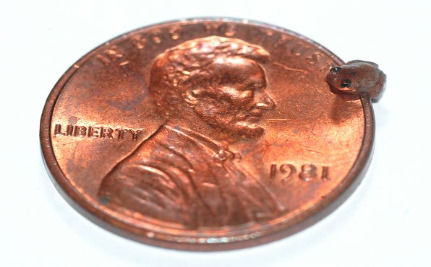
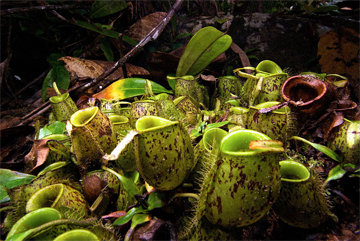
Although the frog, (the Matang Narrow-mouthed Frog) Microhyla nepenthicola, is no bigger than the size of pea when fully grown, it lives fearlessly inside and around carnivorous pitcher plants in Malaysian rain forests.

“The tiny amphibian was officially introduced to the world on Wednesday, but researchers say that they have been hiding in plain view for more than a century.

“I saw some specimens in museum collections that are over a hundred years old,” co-discoverer Indraneil Das said in a statement.

Originally, many scientists thought that the frogs were simply juveniles of other species, but now realize they are actually adults of this newly discovered microspecies.

Despite its tiny size, the frog produces a loud, distinct croak, which is why scientists were finally able to locate it.

“You often get tiny frogs making quite a noise,” said Robin Moore, a herpetologist who was not involved in the discovery told NationalGeographic.

Moore is heading a Conservation International project to rediscover a hundred species of “lost” amphibians that have been declared extinct within the past decade.

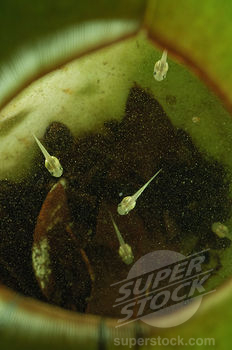
The tadpoles live in the pools of water and digestive enzymes inside the pitchers of Nepenthes ampullaria as seen in the below photos.

When we discover amazing species such as Microhyla nepenthicola that have developed incredible adaptations for survival such as living inside carnivorous plants we are astounded and marvel at its beauty and complexities.
However, amphibians such as this tiny frog are vanishing all over the world due to pathogens such as the Chytrid fungus–a terrible frog plague that is responsible for wiping out entire species of frogs in the last few decades. Frog farming for frog legs and moving species around the planet for the pet trade have spread the Chytrid fungus and other pathogens around the globe.  Toxins created and applied to our farms, gardens, yards, homes and bodies by us such as Triclosan (found in many household chemicals) and Atrazine (a common herbicide) are mutating and killing amphibians and other wildlife all over the world.
Why do we allow this to continue?
A tiny creature such as this frog could vanish in an instant and we would never know. Now that we know of its existence it is up to us to preserve it and its habitat and to protect it from us.
Please do all you can to help Save the Frogs.   Some simple things you can do to help frogs is not eating frog legs, not using any products that contain Triclosan and working to ban the use of Triclosan and Atrazine from production and use all over the world.  Also please consider making a donation to non profit conservation organizations such as Save the Frogs and Earthshine Nature who are working to spread awareness of the value of amphibians and nature conservation to all.
Thank You

Wildlife Tracking Update

Over the last few days I located the sleeping box turtles and rattlesnakes.  The turtles remain tucked away under a warm blanket of leaf litter and the snakes are still hidden deep in their underground lairs.

When tracking Zoe the female Timber rattlesnake I noticed an area of pressed down leaves just in front of the hole she uses to move in and out of her hibernacula.  It is possible that over the last week–with the daytime temperatures in the high 60’s–that she may have moved outside to bask in the record temperatures.

I used a Whites metal detector to detect the transmitters attached to both of the sleeping box turtles in the hopes that I will be able to use it to locate the missing Mr. Bones.  It worked very well and I hope to try it out very soon.  That’s Mr. Bones pictured below.

Turtle Tracks Update Fall 2011

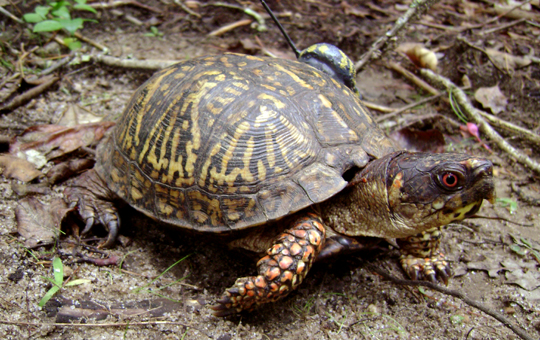
It has been a great year for Jimmy Irwin and Catherine–the resident turtles at Earthshine Lodge.  They both had active summers with lots of good rains and great opportunities for moving about the mountain, feeding and meeting other turtles.  While I did not observe Jimmy with any other turtles this year, it was very different with Catherine.  I found her mating with two different males once near Earthshine and again over Richland Ridge where she spent most of the summer!  It seems that Catherine is a very popular turtle and hopefully the future of box turtles on the mountain is safe within her shell.  Take a look at the video below from one of the times I found Catherine with a male.

Jimmy and Catherine have both put on reserves of fat for the long winter’s torpor and now seem to have chosen their overwintering sites for this year.  Catherine is in the almost exact location–within inches–of where she spent the previous winter and Jimmy is within about two feet of his last years overwintering site.

Mrs. Bones, one of the turtles on our Cedar Mountain study site–seems to have also decided on her overwintering location for this year.  The site she has chosen is only ~30 feet east of the last two years’ overwintering sites.  The last time I located her–on the 15th of November–she was not visible on the surface and in an area of dense Rhododendrons and Mountain Laurels beside a huge rotting pine log.

Mr. Bones, who lives in the same forest as Mrs. Bones, has been missing due to a malfunctioning transmitter since the late summer of 2010.  I have tried to locate him several times using turtledogs and technology but to no avail–he remains MIA.

It is truly amazing to me that the box turtle has such a powerful instinct that allows it to consistently find the same tiny spot in such a huge forest.  Like the ancient sea turtle who can find the beach where it was born, the box turtle has the same instinct to return to the same feeding, overwintering and nesting locations year after year.

If you find a box turtle (or any other turtle) crossing a road simply pick it up and move it off the road in the direction it was facing.  You do not need to take it to a new forest–that is not its home–it will try to walk home to where you found it.    This is only one of the many reasons that you should never take a wild box turtle home.  There is sometimes cause to take a box turtle home with you: if it is injured or sick and will be returned to its origin after it has recovered or if you are 100% certain that it has lost its home due to development or other habitat loss.  In the later case, if you are not willing to care for it then you will need to find it a home in a nature center, zoo or wildlife park because it has no home to return to.