MERRY CHRISTMAS and HAPPY HOLIDAYS to ALL!
 Merry Christmas and Happy Holidays from all of us to all of you…no matter what your species!
Merry Christmas and Happy Holidays from all of us to all of you…no matter what your species!
Over the last few days I located the sleeping box turtles and rattlesnakes. The turtles remain tucked away under a warm blanket of leaf litter and the snakes are still hidden deep in their underground lairs.
When tracking Zoe the female Timber rattlesnake I noticed an area of pressed down leaves just in front of the hole she uses to move in and out of her hibernacula. It is possible that over the last week–with the daytime temperatures in the high 60’s–that she may have moved outside to bask in the record temperatures.
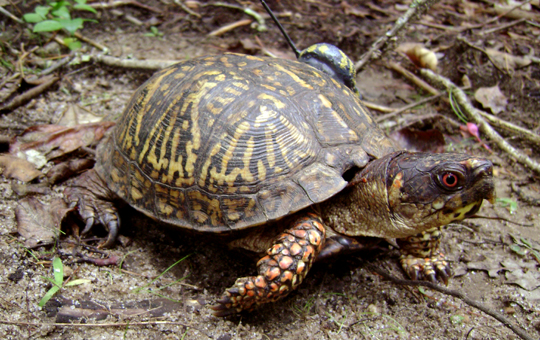
I used a Whites metal detector to detect the transmitters attached to both of the sleeping box turtles in the hopes that I will be able to use it to locate the missing Mr. Bones. It worked very well and I hope to try it out very soon. That’s Mr. Bones pictured below.
Skin stories aplenty!
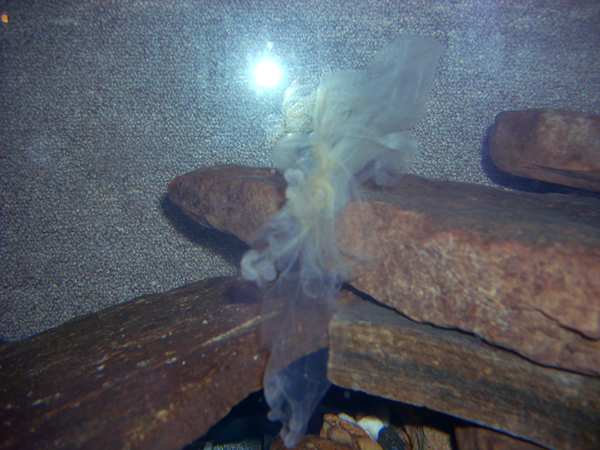
As I watched Gollum first rubbed his nose against a rock a few times and then seemed to convulse–and pop off came his skin! It floated like a wraith out of his hide cave and into the current where I was able to quickly snap this photo–complete with reflection from the flash (oops)–and then only seconds later it was sucked into a circulation pump and shredded into thousands of tiny pieces! Amazing!
Now take a look at one of the newest animals in the Earthshine Nature Center–an Albino Bullfrog with his crazy yellow skin!!
 This is “One” of two…”Two” is not pictured but looks like “One’s” twin. They are albino American Bullfrogs and they are quite striking in their yellow skins. Albinism is the lack of pigments in the skin that in amphibians and reptiles creates a yellowish appearance with red-pink eyes. In mammals it creates white coats with red-pink eyes. Very cool!! Albino animals usually do not live very long in the wild because their natural camouflage is not in effect and they stand out to predators and are eaten quickly. One and Two were bread in captivity and will live at the Earthshine Nature Center so they will not have to worry about predators. Come see them today!
Now check this out! A Giant Hissing Cockroach shedding its skin!!
 Like snakes, insects such as this roach must shed their entire skins as they grow. This roach’s old skin is splitting down the dorsal side and the soft white roach, with his new larger skin is wiggling out. After he is out his new skin will solidify over the next few hours-days and turn brown after-which he will go on about his roachy life.
So cool!!
Please consider donating to Bob Irwin’s cause to help Rainforest Rescue save the rainforests and the endangered Cassowary!
Thank you!
Follow this link to learn more.


It seems sad but true–the Japanese government has allocated 29 million of the post Tsunami Recovery fund to help provide security and support for this years illegal whaling expedition to the southern ocean whale sanctuary. If you gave money to help the victims of the tsunami and nuclear disaster japan is now using some of it to KILL WHALES!!!! Read more about it at this link.
Hopefully, the Sea Shepherds will keep them under control in this years campaign: Operation Divine Wind.
 Late one evening in the summer of 2010 I received a wildlife rescue call from a man who said that he had a Copperhead entangled in a piece of yard netting. I asked him if he was sure that it was a Copperhead and he said yes. I was still skeptical because people often confuse several different species of harmless snakes with Copperheads…but whatever kind of snake it was I knew that I had to rush to the scene and try to help the entangled snake. The reason I felt like I needed to rush was that the snake had been stuck in the netting for around 48 hours! I drove the 20 miles or so to the location and found that in fact the snake was a venomous Northern Copperhead and it was severely entangled in a tangled mass of plastic yard netting. The homeowner, a concerned lover of all wildlife, had taken the time to set up a work light over the area where the snake was tangled so it would make it easier for me to work. After looking over the situation I quickly realized that I would need tools to keep me away from the business end of the snake because although I was trying to help it survive, it might not realize that and could potentially envenomate me. I borrowed a pair of scissors and an xacto knife from the homeowner and began to cut away the netting. As I cut I saw that the snake was exhausted. Its lengthy entanglement in the netting and struggling to free itself had pushed it to the edge. It was so tired that it could barely move–it was undoubtedly dehydrated and possibly in shock from spending the day in summers heat even though the homeowner had the foresight to keep the snake in the shade and occasionally sprinkle cool water over it to keep it from overheating–these actions are what surely kept the snake alive until I could free it from the netting. I worked slowly and carefully moving from the tail toward the head cutting the netting one strand at a time. I used scissors where the netting was looser and had to use the xacto knife–a type of razor–to cut the net strands where they were pressing tightly against the snakes’ skin. When I got close to the snakes head I had to be very careful not to hurt it and not to get hurt myself. I was finally able to gently cut the last piece of netting free and the snake went limp and took a deep breath and flicked its tongue a few times. I gently placed a clear plastic tube over the snakes head and first few inches of its body so that I could examine it for injuries without any danger of it biting me. It was so exhausted that it just let me pick it up in the tube and give it a quick check before releasing it into the nearby woods where it crawled slowly toward a nearby creek obviously quite happy to be free. I thanked the man who shared habitat with the snake for taking care of him until I could free him from the netting and felt good in the knowledge that I had helped this small snake survive.
Some may wonder why I went to such trouble to rescue a venomous snake. I do so because venomous or non-venomous all snakes are part of a healthy ecosystem and they should be allowed to live and thrive and play their part in a healthy ecosystem. Without snakes and other carnivores helping to control populations of other animals like rodents, birds and insects, nature would quickly fall out of balance and the disastrous consequences of species overpopulation could follow.
Snakes are one of the most beautiful and beneficial but also one of the most misunderstood and mistreated creatures on Earth. Please, if you encounter a snake in the wild or in your yard please do not kill it or harm it in any way–step back and marvel at its beauty and complexity and learn more about its uniqueness and connectedness to nature and to all of us.
Please consider not using plastic yard netting if at all possible. It is notorious for trapping and killing all sorts of wildlife from reptiles and amphibians to birds and deer.
Watch a short movie of this snake rescue below.
View all of Naturalist Steve’s nature and wildlife conservation and education videos on his YouTube channel.
For more about Earthshine Nature Programs and Earthshine Naturalist Steve O’Neil check out the Earthshine Nature Programs website.
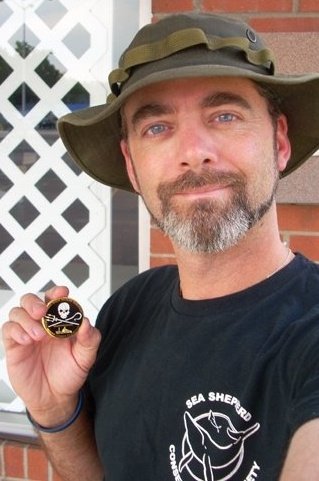
ENP Executive Director Steve O’Neil is a self proclaimed Wildlife Warrior who fights for wildlife conservation through exciting hands-on education, unique wildlife conservation projects, wildlife rehabilitation and onsite and in the field outreach programs. Steve has now branched out to help save the largest creatures on the planet–whales! Steve has become a Whale Warrior and joined forces with the Sea Shepherd Conservation Society in their fight to save whales in the southern oceans. In the next few weeks Steve will be setting up a Sea Shepherd display in the Earthshine Nature Center. The display will have informational materials, a video and more that will teach visitors about how they can be a part of the fight to save the whales from extinction. Take a look at Steve’s Whale Warrior website for more information and to find out how you can help Steve help the Whales.
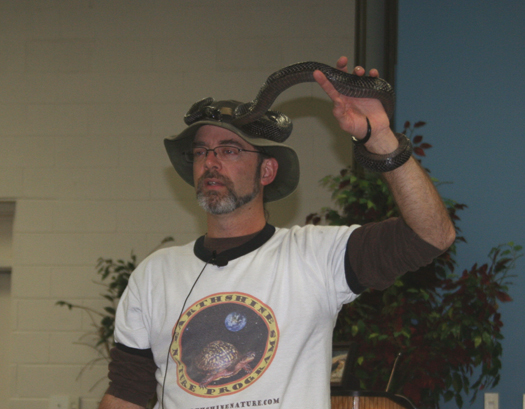
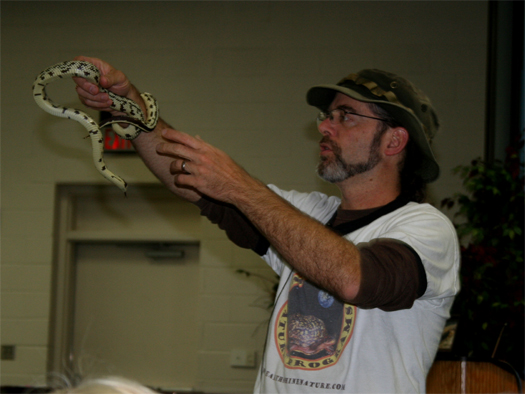
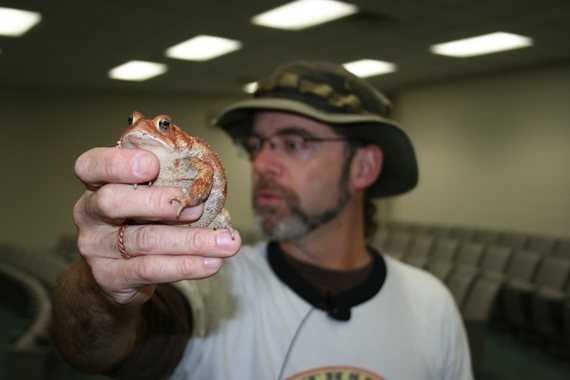
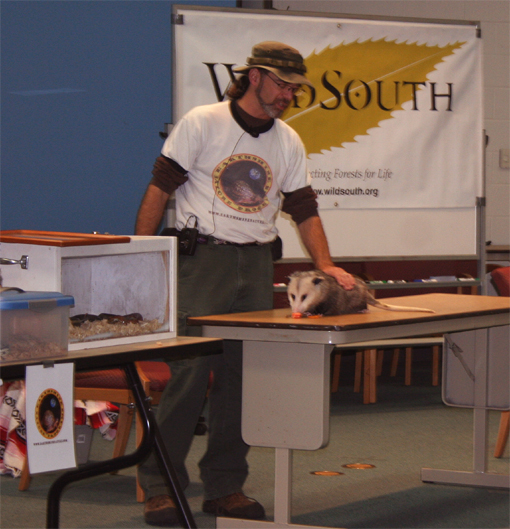
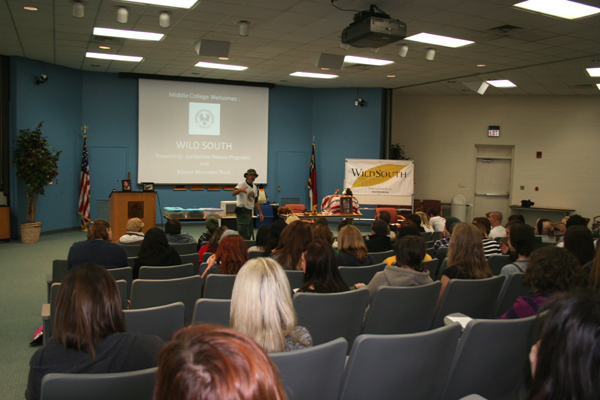
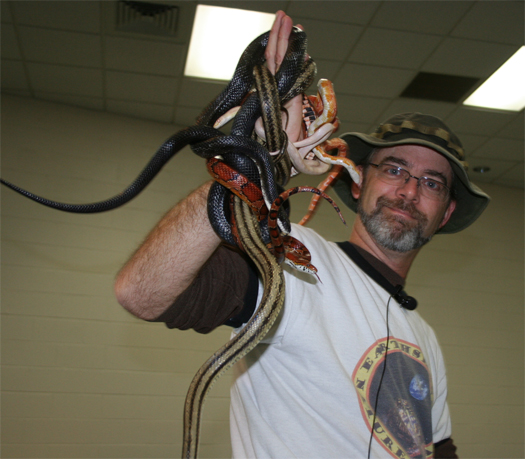
A few weeks ago I presented a wildlife show for a group at AB Technical College in Asheville, NC. It was a great show with close to 100 students in attendance. THANK YOU to WILD SOUTH for supporting me for this event! Check out some of the photos from the event below: (Photos by Tom Copeland)
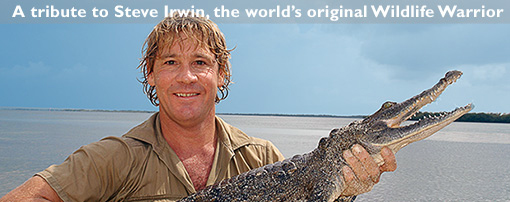
Steve Irwin "The Crocodile Hunter" and a friend
In 2006 the world lost a great warrior for wildlife–Steve “The Crocodile Hunter” Irwin. Steve was one of my biggest heroes so I wanted to do something as a tribute to his memory and hard work saving wildlife and wild places and educating people on the value of our wildlife–from the cute and cuddly, warm and fuzzy to the toothy scaly and slimy and not-so-cuddly critters. So I got in touch with my friend Aaron Weed–the owner of Coins and Pins, maker of some of the worlds most beautiful and unique commemorative and Geocaching items–and we came up with a design for the Crikey! Fundraiser Geocoin–a memorial geocoin that would have a very special mission.
At first you may think that a simple coin doesn’t seem like much of a memorial to a man who had such a great influence on so many people all over the world. This was much more than a simple coin. I designed this coin to benefit Wildlife Warriors Worldwide and the first minting did just that. ALL money generated from the sale of this memorial coin (minus production costs) was directly donated to Wildlife Warriors Worldwide. With this second minting ALL money generated (minus production costs) will be divided 50/50 and donated to Wildlife Warriors Worldwide and The Bob Irwin Wildlife Fund to be used for the conservation of wildlife and wildlife habitat that Steve and Bob Irwin are so passionate about protecting.
I hope this coin will serve not only as a reminder of the man Steve Irwin but also as a reminder of his message of the great importance of wildlife conservation and public education about wildlife and their relationship to mankind. The Crikey coin’s insert will carry the web address of its website and hopefully, those who hold this coin will view the website and be inspired to donate further to the conservation of wildlife and wild places and then together we all can help make a real difference in wildlife conservation worldwide. I would also wish that as the coins are bought, sold and traded in the years that follow their initial sale, that the people that acquire them will feel it in their hearts to donate further to Wildlife Warriors Worldwide, The Bob Irwin Wildlife Fund, Earthshine Nature Programs or a similar wildlife conservation cause in their area.
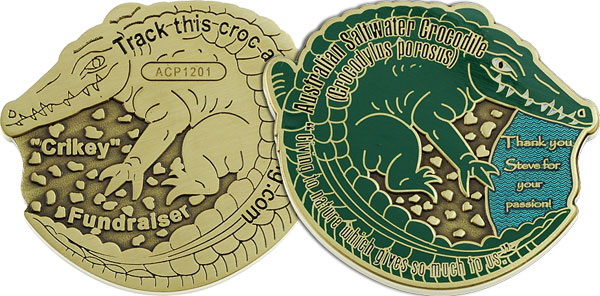
To order your Crikey! Fundraiser Geocoin just follow this link.
Thank you all for supporting wildlife conservation and education.
Steve
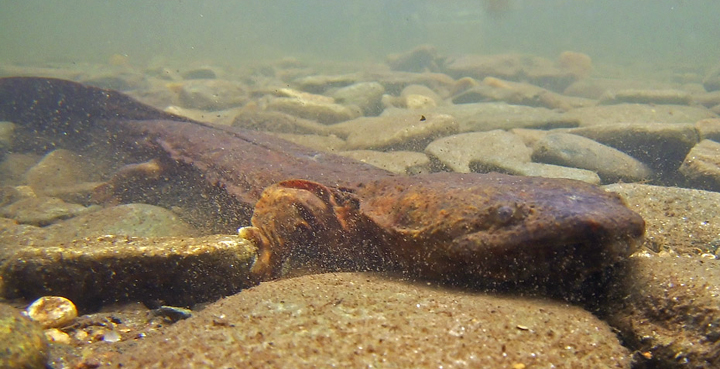
St. Louis Zoo’s WildCare Institute is Hell-Bent on Saving Hellbenders with the First-Ever Hatching of Ozark Hellbenders
Jordan Schaul of The Alaska Wildlife Conservation Center
National Geographic Daily News12/2/11
In 2007, the St. Louis Zoo’s WildCare Institute announced that their staff herpetologists, including herpetoculturists, and colleagues had achieved the first-ever laying of Ozark hellbender salamander eggs in captivity using only environmental cycling. Although the eggs were not fertile, this was a monumental achievement for hellbender propagation and conservation.
Last month, after a decade of collaboration, the Ron Goellner Hellbender Conservation Center at the Zoo’s Herpetarium and the Missouri Department of Conservation (MDC) officially established a successful breeding program for hellbenders with the hatching of Ozark hellbenders. Neither the federally endangered Ozark hellbender or the more common subspecies– the Eastern hellbender–have ever been bred in captivity. Missouri, incidentally, is the only state where both subspecies of hellbenders occur.
My first encounter with an “Allegheny Alligator” was in front of a glass terrarium at the Cleveland Museum of Natural History. I had signed up for a graduate class in herpetology taught by the museum’s Curator of Vertebrate Zoology, Dr. Tim Matson– a salamander aficionado and expert. So it did not come as a surprise that like other scholastic teaching venues in the organismal sciences his had a living, wet animal ambassador hanging around.
The accepted common name for our classroom’s resident giant salamander is hellbender. In the vernacular you will find colloquial names like “snot otter”, “devil dog”, and “grampus”–all fairly pejorative names. At first glance they do look rather fierce and perhaps unsightly, but they are actually quite docile aquatic amphibians. Since writing about their close relatives, the larger Japanese giant salamanders and visiting them on exhibit here in the states, I have come to think of the cryptobranchids as beautiful animals.
A little bit of folklore and my own imagination lead me to believe that this bizarre amphibian species was a formidable foe. Having sustained bites from small, lungless plethodontid salamanders to bites from juvenile crocodillians, I was a bit wary of this unfamiliar herpetile where as my classmates questioned if it was actually alive. These solitary salamanders don’t move a whole heck of a lot once they get comfortable.
Hellbenders can bite if provoked, but it is fairly rare. These salamanders, the smallest of giant salamanders, attain lengths of over two feet and have lived as long as 29 years in captivity. With skin that is brown with black splotches, the Ozark hellbender has a slippery, flattened body that moves easily through water and can squeeze under rocks on the bottom of streams.
Since 1981, hellbenders were listed as extinct or endangered in four states and remain threatened throughout the rest of their range. Endemic to the U.S., there are two subspecies as mentioned: the Eastern hellbender and the Ozark subspecies.
The Ozark hellbender (Cryptobranchus alleganiensis bishopi) occurs in riverine habitats of southern Missouri and northeastern Arkansas and specifically in two river systems. They require cold, clean water to survive. “Capillaries near the surface of the hellbender’s skin absorb oxygen directly from the water–as well as hormones, heavy metals and pesticides,” said Jeff Ettling, Saint Louis Zoo curator of herpetology and aquatics. “If there is something in the water that is causing the hellbender population to decline, it can also be affecting the citizens who call the area home.” To ecologists they are barometers of ecosystem health–likened to “canaries in a coal mine”.
Over the past three decades populations of both salamander subspecies have succumbed to anthropogenic stressors aside from just habitat degradation (i.e. stream impoundments, pollution and siltation) and habitat loss; they have also been impacted by collectors seeking specimens for the pet trade.
There are only about 590 Ozark hellbenders in the wild. At one time there were 8,000 of these highly aquatic caudates living in the Southcentral Missouri waterways. The Ozark subspecies has seen a precipitous decline–a 70% decline–in the last decade. Due to these drastic declines, captive propagation became a priority in the long-term recovery of the species. Fortunately, the St. Louis Zoo and the Missouri Department of Conservation were already trying to conserve this vanishing species through sorta situ conservation efforts.
“We have a 15- to 20-year window to reverse this decline,” said Missouri Department of Conservation Herpetologist Jeff Briggler. “We don’t want the animal disappearing on our watch.”
In 2004, funding from private donors, the Missouri Department of Conservation, the United States Fish & Wildlife Service and the Zoo covered the cost of building sophisticated facilities including climate-controlled streams to breed the hellbender.
The hellbender propagation facilities include two outdoor streams that are 40 feet long and six feet deep. The area is landscaped with natural gravel, large rocks for hiding and artificial nest boxes, where the fertilized eggs were discovered. A nearby building houses state-of-the-art life support equipment used to filter the water and maintain the streams at the proper temperature.
In addition, two large climate-controlled rooms in the basement of the Zoo’s Charles H. Hoessle Herpetarium are the headquarters for the program. The facilities recreate hellbender habitat with closely monitored temperatures, pumps to move purified water, sprinklers synced to mimic the exact precipitation and lights that flick on or dim to account for brightness and shade. The largest room includes a 32-foot simulated stream, complete with native gravel and large rocks for hiding. It houses a breeding group of adult Ozark hellbenders from the the White River in Missouri. Once the hellbender offspring reach 3 to 8 years of age they will be released back into the wild.
End of Article.
More awesome news for amphibian conservation! Maybe one day we will see our local wildlife biologists releasing captive raised young Hellbenders into the wild to help repopulate our mountain Hellbenders streams and rivers.
If you would like to meet a Hellbender without having to go diving in a frigid mountain river then just drop me an email and we will set up a time for you to meet “Gollum” –Earthshine Nature’s resident Hellbender.
 Earthshine Nature