Spotted Salamanders!

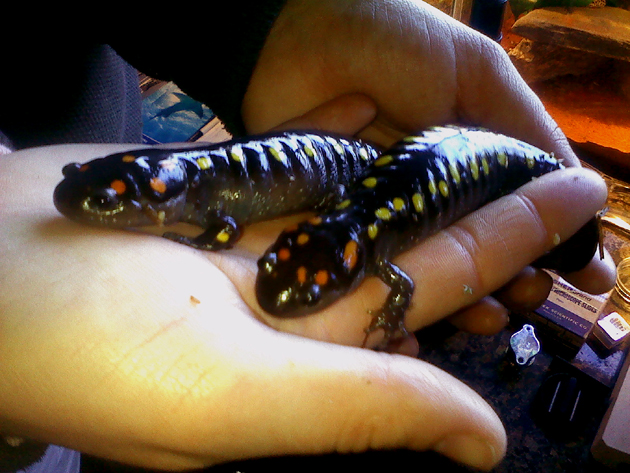
Check out this photo of Earthshine Nature’s spotted salamanders–aren’t they wonderful!

Spotted Salamanders are fairly common in the forests of Western North Carolina but they are seldom seen because of their nocturnal underground lifestyle.  They spend most of their lives in underground burrows searching for invertebrates to feed on such as worms and insects.   They come to the surface in the late winter when the first warm rains of spring lure them onto the surface in search of mates and their egg laying sites–predator free vernal ponds and pools hidden in the forest.  Once they find their pools–sites they return to yearly–they mate and then the females lay large masses of eggs.  The eggs of the spotted salamander are contained within a rather firm yet jellylike mass that protects the developing embryos within.  The egg mass is often covered with a specialized algae that shares a symbiotic relationship with the developing salamander larva.  The larva exhale carbon dioxide which directly benefit the algae and the algae photosynthesize the suns energy creating an oxygen rich environment which gives the embryos the perfect environment for growth.  Amazing!

Count yourself lucky if you are in the right place at the right time to see Spotted Salamanders in the wild–they are a true treasure to behold.

If you have temporary ponds on your property that often fill up in the late winter and spring then dry up in the summer then you may have Spotted Salamanders!  Please consider leaving the ponds intact for the benefit of wildlife that need them such as the Spotted Salamander.

For more information and beautiful photos of Spotted Salamanders and their egg masses check out my friend Alan’s posting on the Wandering Herpetologist Blog.

If you would like to meet our salamanders just email me and I will gladly arrange a visit.

Amazing Gorilla Encounter!

I just saw this video on Youtube of an amazing Gorilla encounter that everyone must watch–it is incredible!

Watch it now before the internet is censored next week and Youtube is shut down.  If you care about keeping the internet FREE and not a crime to use then please fight the SOPA and PIPA act.  Follow this link to read more about SOPA and PIPA and then do all you can to help stop the censorship of the internet.  If the bill becomes a law then educational websites like Earthshine Nature and this blog could be censored and shut down even though we are an educational resource site.  Shortly after I post this article Earthshine Nature Programs will be joining in on the blackout in protest of the SOPA and PIPA act.  Our freedom of speech and information is being targeted so we must stand up and fight for the right to share quality information with each other for the greater good.  If you host a website please consider blacking it out today to join in on the protest.

“New” Tiny Frog Discovered Living Inside Carnivorous Plants

This is an amazing new species of frog that was re-discovered in Borneo.  Read more about it in the original article below.

“Scientists in Borneo have discovered a new species of frog, and think that it may be one of the world’s smallest.

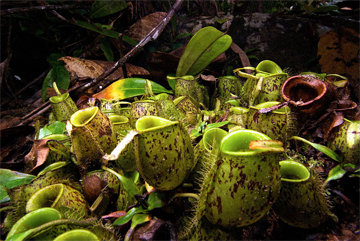
Although the frog, (the Matang Narrow-mouthed Frog) Microhyla nepenthicola, is no bigger than the size of pea when fully grown, it lives fearlessly inside and around carnivorous pitcher plants in Malaysian rain forests.

“The tiny amphibian was officially introduced to the world on Wednesday, but researchers say that they have been hiding in plain view for more than a century.

“I saw some specimens in museum collections that are over a hundred years old,” co-discoverer Indraneil Das said in a statement.

Originally, many scientists thought that the frogs were simply juveniles of other species, but now realize they are actually adults of this newly discovered microspecies.

Despite its tiny size, the frog produces a loud, distinct croak, which is why scientists were finally able to locate it.

“You often get tiny frogs making quite a noise,” said Robin Moore, a herpetologist who was not involved in the discovery told NationalGeographic.

Moore is heading a Conservation International project to rediscover a hundred species of “lost” amphibians that have been declared extinct within the past decade.

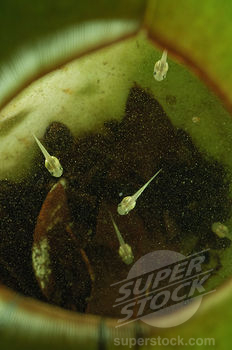
The tadpoles live in the pools of water and digestive enzymes inside the pitchers of Nepenthes ampullaria as seen in the below photos.

When we discover amazing species such as Microhyla nepenthicola that have developed incredible adaptations for survival such as living inside carnivorous plants we are astounded and marvel at its beauty and complexities.
However, amphibians such as this tiny frog are vanishing all over the world due to pathogens such as the Chytrid fungus–a terrible frog plague that is responsible for wiping out entire species of frogs in the last few decades. Frog farming for frog legs and moving species around the planet for the pet trade have spread the Chytrid fungus and other pathogens around the globe.  Toxins created and applied to our farms, gardens, yards, homes and bodies by us such as Triclosan (found in many household chemicals) and Atrazine (a common herbicide) are mutating and killing amphibians and other wildlife all over the world.
Why do we allow this to continue?
A tiny creature such as this frog could vanish in an instant and we would never know. Now that we know of its existence it is up to us to preserve it and its habitat and to protect it from us.
Please do all you can to help Save the Frogs.   Some simple things you can do to help frogs is not eating frog legs, not using any products that contain Triclosan and working to ban the use of Triclosan and Atrazine from production and use all over the world.  Also please consider making a donation to non profit conservation organizations such as Save the Frogs and Earthshine Nature who are working to spread awareness of the value of amphibians and nature conservation to all.
Thank You

Lions, Tigers and Bears…Oh My!

This is  GREAT story about tolerance, forgetting your differences and living together in peace.  We so called “civilized and superior” humans should take a lesson from this story and learn from the animals how to better relate to one another!  Thanks Alan for sending it to me.

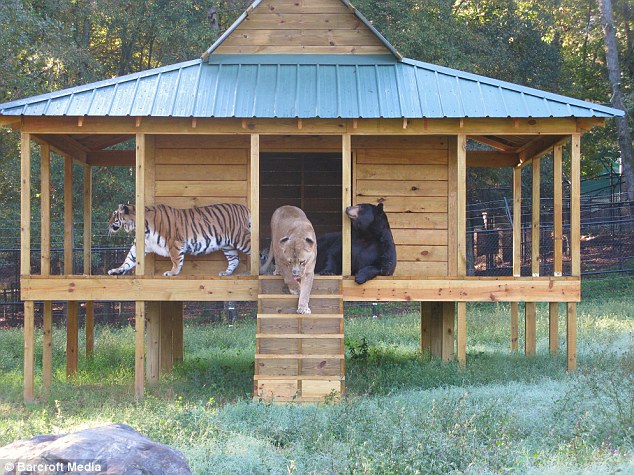
They make an unlikely trio, but Baloo the bear, Leo the lion and Shere Khan
the tiger have forged an unusually strong bond.

Considering that they would be mortal enemies if they ever were to meet in the
wild, it is stunning to see their unique and genuine friendship in these intimate
pictures.

Rescued eight years ago during a police drugs raid in Atlanta ,Georgia,
the three friends were only cubs at the time, barely two months old.
 

They had been kept as status symbol pets by the drug barons.

Delivered to the Noah’s Ark Animal Rescue Center in Locust Grove, Georgia,
the decision was made to keep the youngsters together because of their
budding rapport.

‘We could have separated them, but since they came as a kind of family,
the zoo decided to keep them together,’ said Diane Smith, assistant
Director of Noah’s Ark.

‘To our knowledge, this is the only place where you’ll find this combination
of animals together.’

Living with the zoo’s founders for the past eight years, Shere Khan, Baloo
and Leo have now moved to a purpose-built habitat where the US public
can now witness first hand their touching relationships.

‘We didn’t have the money to move them at first,’ said Diane.

‘Now their habitat is sorted and they have been moved away from the children’s
zoo areas where the public couldn’t really get a good look.

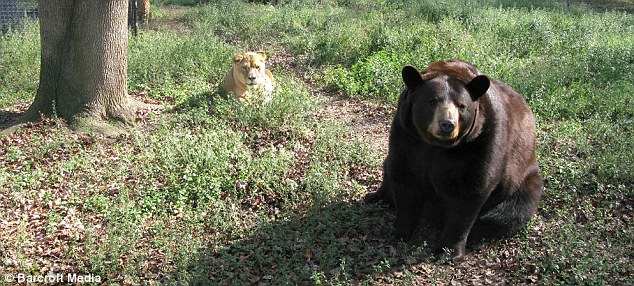
‘It is possible to see Baloo, who is a 1000lb bear, Shere Khan, a 350lb tiger
and Leo, who is also 350lbs, messing around like brothers.

‘They are totally oblivious to the fact that in any other circumstance they would
not be friends.’

Handled by Charles and Jama Hedgecoth, the zoo’s owners and founders,
the three friendly giants appear to have no comprehension of their animal
differences.

‘Baloo and Shere Khan are very close,’ says Diane.

‘That is because they rise early, and as Leo is a lion, he likes to spend most
of the day sleeping.

‘It’s wonderful and magical to see a giant American Black Bear put his arm
around a Bengal Tiger and then to see the tiger nuzzle up to the bear like a
domestic cat.

‘When Leo wakes up, the three of them mess around for most of the day
before they settle down to some food.’

Surprisingly, for three apex predators with the power to kill with a single bite
or swipe of their paw, they are very relaxed around each other.

‘They eat, sleep and play together,’ said Jama.

‘As they treat each other as siblings, they will lie on top of each other for heat
and simply for affection.

‘At the moment they are getting use to their new habitat.
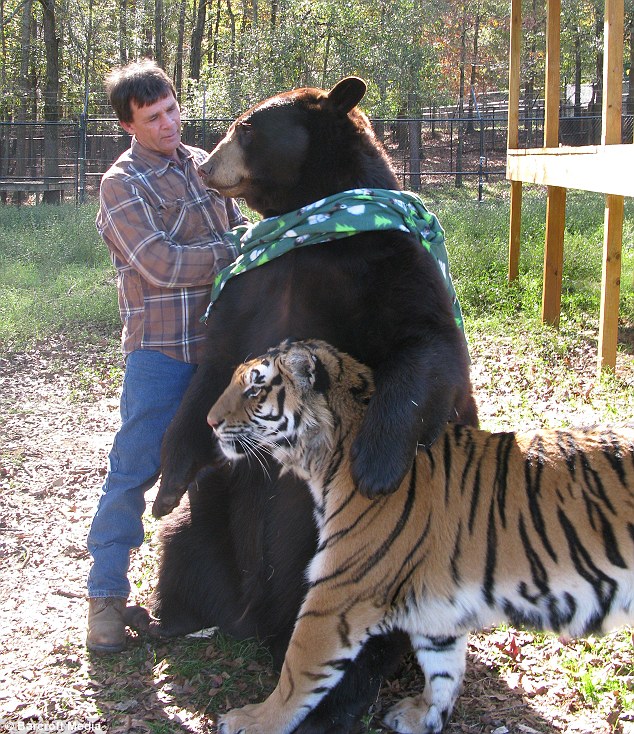
‘Shere Khan is being quite reticent about the move, but Baloo, the bear, is very
good at leading him on and making him feel comfortable and safe.’
Explaining that the three ‘brothers’ have always seemed to share a unique
bond, Charles said: ‘Noah’s Ark is their home and they could not possibly be
separated from each other.

‘You just have to remember who you’re dealing with when you are with them,
though.

‘It’s when you forget that these fellows are wild animals that you get yourself
in trouble.’

The trio’s new habitat had to be constructed carefully, in order to accommodate
its occupants.

Jama said: ‘The clubhouse had to be very sturdy for the guys, because they all
sleep in it together,’  She added: ‘We had to include a creek, because the tiger
and the bear both like to be in water.’

Learn more about Noah’s Ark Animal Rescue and Children’s Center on their website.
It is no wonder the tortoise won the race…he was smarter than the hare.


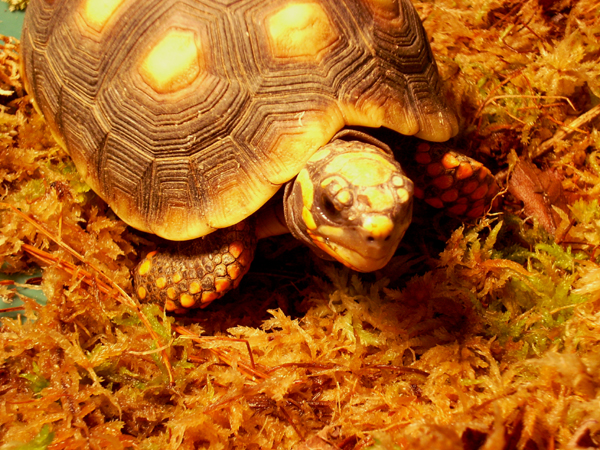
Many people believe reptiles to be dim witted but I know that is far from the truth.  Through my radio tracking studies of box turtles I have observed some truly amazing things about the life of the box turtle. How do they find and follow the same paths, feeding, nesting and over-wintering areas and even sometimes the same mates year after year?  They are obviously not using radio tracking devices, high tech satellite-linked computers or GPS systems like we big brained primates seem to think we need to get around.  New studies are beginning to show that the chelonians (turtles and tortoises) are far brighter than we have ever believed.  Over the years my observations of the turtles in the Turtle Tracks study have led me to believe without a doubt that the tiny brain of the box turtle has much more intelligence and capability to learn than we have ever thought possible. Researchers have begun to discover that in fact tortoises (and turtles I’m sure) do in fact have much more going on inside their little noggins than we give them credit. Take a look at this article from New Scientist and read all about it and then, the next time you encounter a chelonian, marvel at it’s existence.  Feel humbled that we “advanced” animals need our invented technologies and education to navigate our way through life but the chelonian needs only the adaptations, instincts and smarts they are born with to make a good living in the wild…and that they have done so since the time of the dinosaurs.  Nature never ceases to amaze and astound me.

Amazing Whale Rescue Story!

Watch the video of this is a wonderful story by Michael Fishbach, co-founder of The Great Whale Conservancy (GWC), Watch the video and follow as he narrates his encounter with a young humpback whale entangled in local fishing nets.

At first, the animal appeared to be dead, yet Fishbach investigated and quickly discovered that the poor creature was tangled in a fishing net. The humans had to act fast; what began as a tragedy soon became a thrilling rescue as Fishbach and his crew labored to free the young whale. The entire encounter was caught on videotape and later narrated by Fishbach himself.

This young whale knows how to show appreciation by treating them to a magnificent aerial spectacle after it was finally freed.

CHECK THIS OUT!!

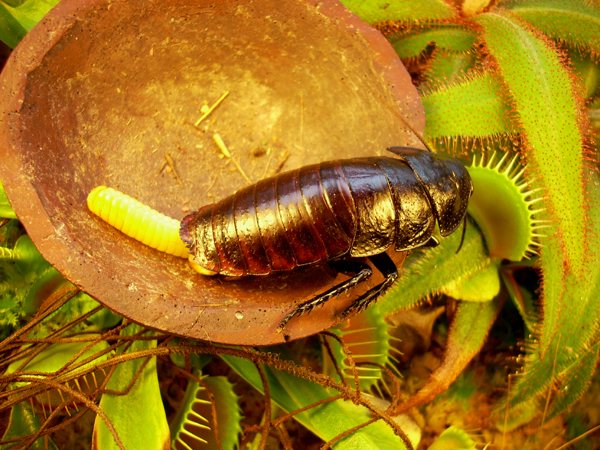
Check out one of the Hissing Cockroaches showing off her Ootheca!!

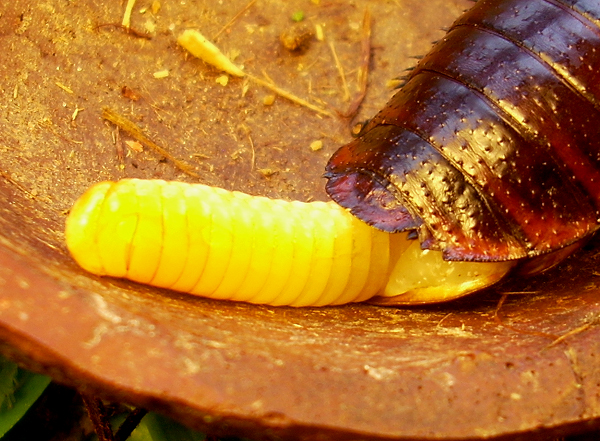
Hissing Cockroaches retain their ootheca (egg case) until birth of the young.  They do this rather than depositing it immediately as other insects do.  Sometimes they extend their ootheca outside of their abdomen for periods of time as in these photos.  The function of this behavior is unknown, but it seems that the female is either thermoregulating or ‘air drying’ the ootheca before retracting it into her body before the birth of the young nymphs.  Baby roach photos soon!  

  Here’s a close up!

Some may think of roaches as gross, disease carrying pests but they are very important parts of a healthy forest because they are decomposers.  Roaches eat decaying organic material–primarily vegetation–and process it into waste that is usable fertilizer for forest plants.  They are also food items for many creatures such as lizards, toads, frogs, snakes, birds, mammals and in some regions even people!  Only a few species of roach are pests to humans and luckily the Madagascar Hissing Cockroach is not one of them.  Isn’t nature amazing!!

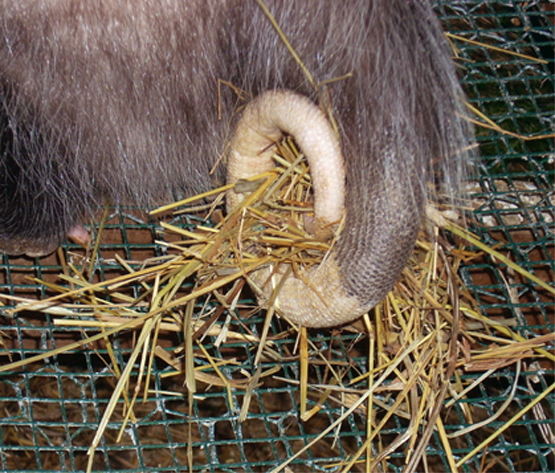
Now take a look at Potter.

He is gathering straw to insulate his bed and yes, he is using his tail!  Opossums have a prehensile tail and use it to carry bedding materials and grip branches when climbing.

…but they don’t sleep while hanging from their tail as the stories say.    Way to go Potter!