Zoe and Utsanati have left the power line access way and moved into the forest closer to their over-wintering sites. We found Zoe underground in her interim den but we were unable to visually locate her. This is a site that she used last year at this time just before she entered her primary den which is located only ~150 from the interim den. She again used this site this past spring as a a resting place just after she came out of hibernation. It is obvious that she knows exactly where she is and exactly where she is going.
We found Utsanati on the surface in a resting coil only a few hundred feet uphill from his den site. It will be very interesting to see if both snakes return to their last winter’s den sites.
Utsanati. Photo by Fred Bahnson
Watch the video from today’s expedition below.
If the video does not show then you can watch the video on my Youtube channel.
I am not paid to conduct this research–this is a volunteer project that I am undertaking to learn all that I can about these greatly misunderstood and amazing animals to further educate you about their beauty, uniqueness and intrinsic value to a healthy forest ecosystem.
If you would like to support the Snake Tracks Timber Rattlesnake wildlife conservation, research, and education project and/or Earthshine Nature Programs please feel free to donate using this link. Receipts available upon request. You may also donate supplies such as animal foods, medical supplies, vitamins and habitat supplies. If you are interested in donating any of these items please contact us for more information on our current needs. THANK YOU to all of you who have donated to ENP!! Without you this important work would not happen.
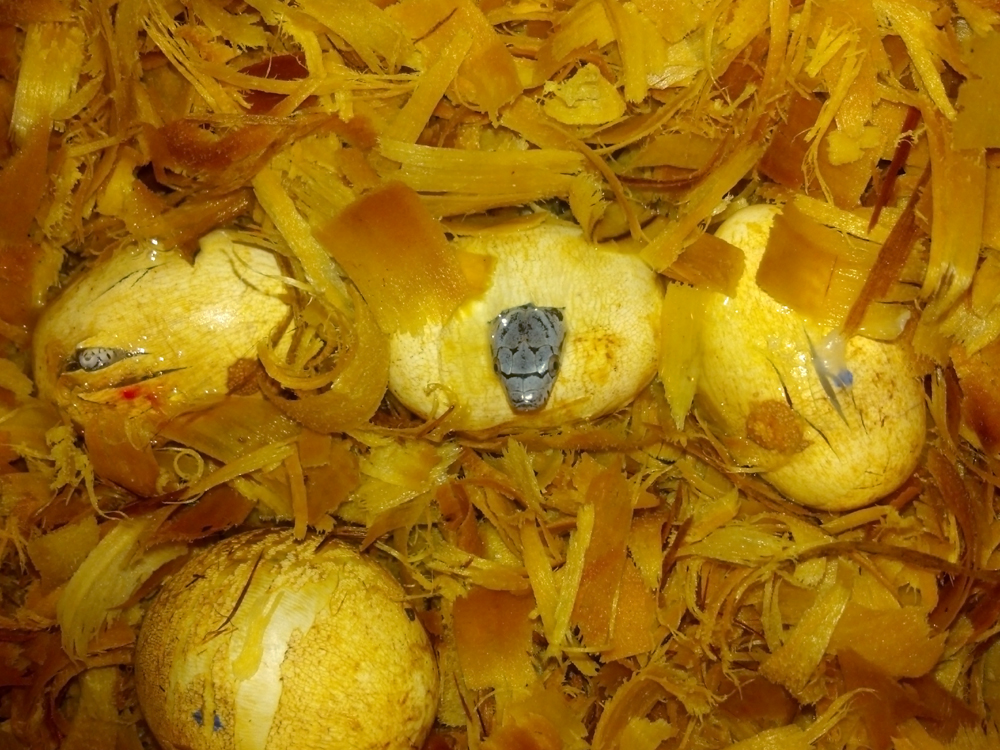
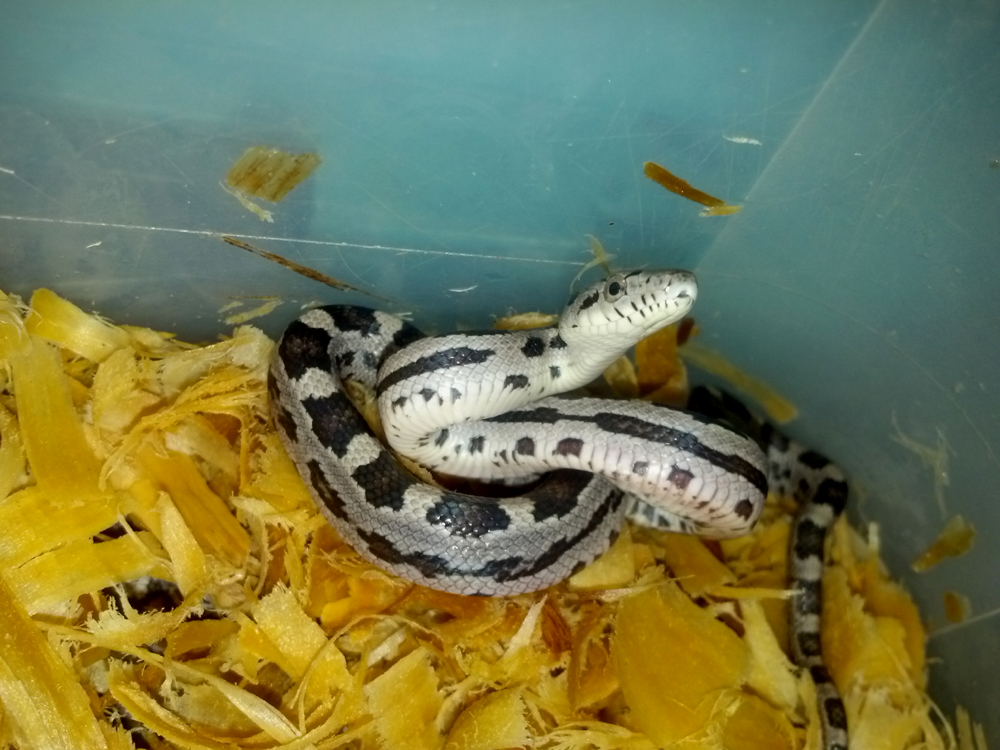
A few months ago I found several ratsnake eggs in the “ratsnake skyway” habitat at the Nature Center. I am unsure which snake laid them but it had to be Lori (Yellow ratsnake) or Xena (Albino ratsnake). The father was either Scar (Black ratsnake) or Heyward (Grey ratsnake). I placed the eggs in a makeshift incubator and hoped for the best and about a week ago they started hatching! Take a look at the photos and video below for great vision of all the action!
In the first photo the eggs have just starting to hatch. The small cuts on the eggs are from the baby snakes using their egg tooth’s to cut the shell open from the inside. The egg on the lower left has a tiny snake nose poking out to sniff the big world!
Do I really want to come out of the safety of this warm egg?
Just hatched!
Hello world! I am a ratsnake and I am here to eat rats!
One of the babies was born with a spinal defect and did not survive so it was fed to King the Eastern Kingsnake. Watch the short video below to watch the feeding and see the baby snakes!
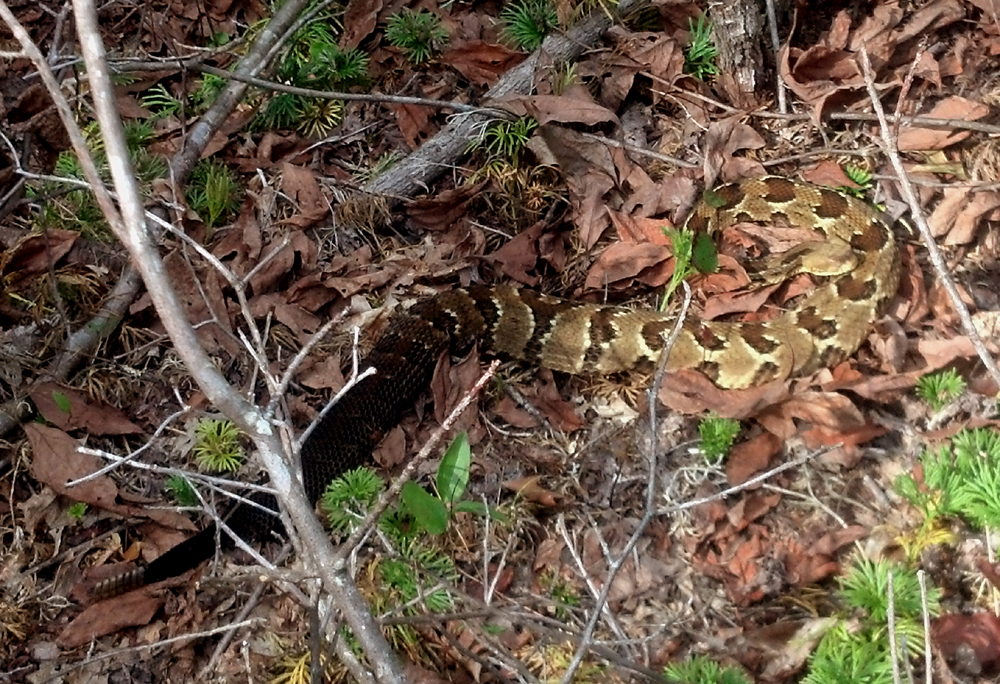
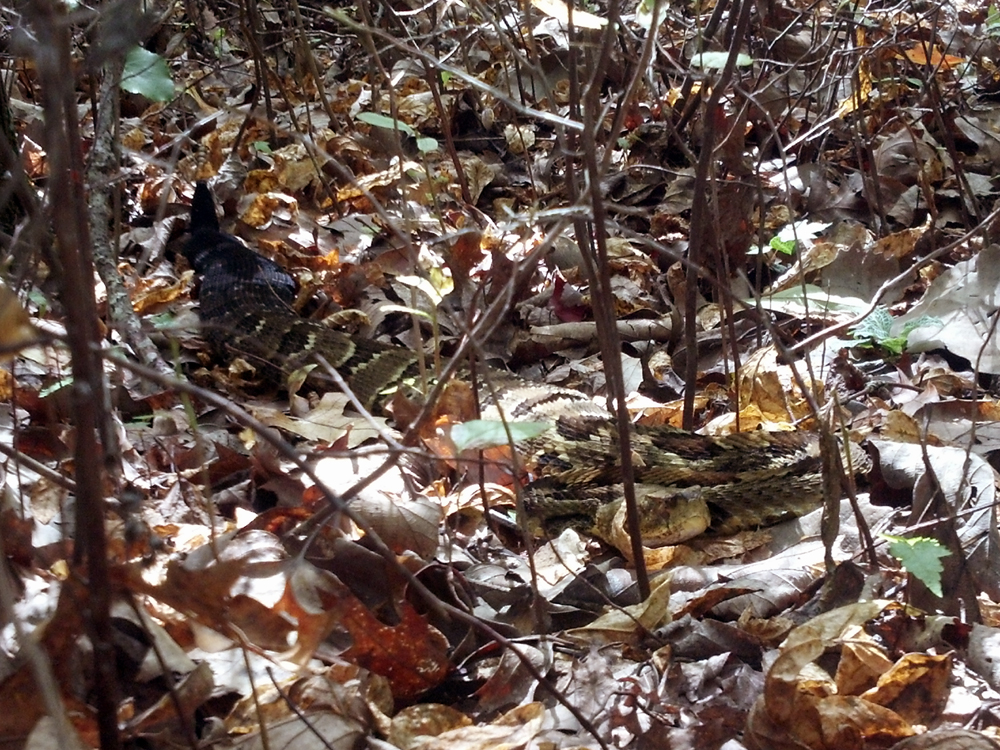
Today I found both rattlesnakes deep in the forest far from areas of Human habitation or visitation. They were only ~40 feet apart within the power line access way. Zoe was sunning in the open under some brush and Utsanati was coiled at the base of a Mountain Laurel shrub beside the “trail.” It is interesting to note that while tracking Zoe I had unknowingly walked within 2 feet of Utsanati and he never once moved or rattled!
Here is a photo of Utsanati.
Both snakes never rattled or acted aggressive upon my approach–they just remained coiled in resting coils despite the fact that I was only a few feet away as I collected my data.
Zoe as I found her.
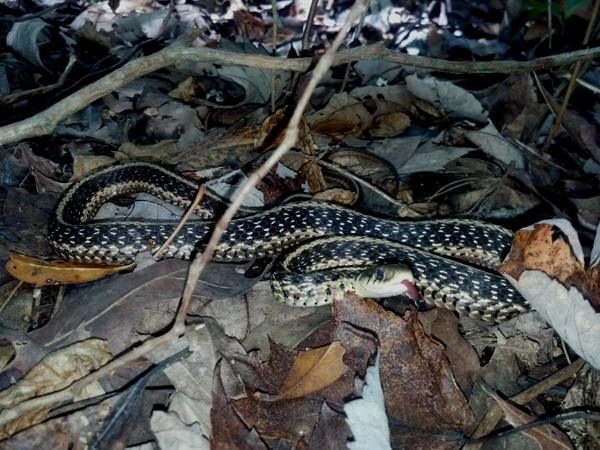
After locating both rattlesnakes I made my way back up the steep mountainside and almost stepped on this little cute garter snake.
He posed for several photos and video–he was a bit more wary of me than the rattlesnakes who I believe have gotten used to me visiting them occasionally.
Take a look at the video footage from today below:
If the video does not show then you can watch the video on my Youtube channel.
I am not paid to do this research–this is a volunteer project that I am undertaking to learn all that I can about these greatly misunderstood and amazing animals to further educate you about their beauty, uniqueness and intrinsic value to a healthy forest ecosystem.
If you would like to support the Snake Tracks Timber Rattlesnake wildlife conservation, research, and education project and/or Earthshine Nature Programs please feel free to donate using this link. Receipts available upon request. You may also donate supplies such as animal foods, medical supplies, vitamins and habitat supplies. If you are interested in donating any of these items please contact us for more information on our current needs. THANK YOU to all of you who have donated to ENP!! Without you this important work would not happen.
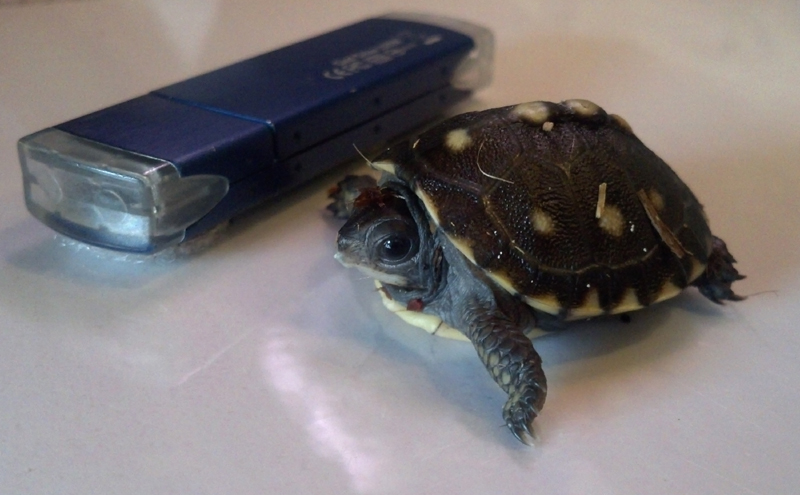
I released three young box turtles today. Watch the video at the end of this post for all the details. The first two releases were hatchlings that I hatched from rescued eggs in the nature center–scroll down to read my previous blog posting and photos of these tiny turtles hatching and read more about their story. Check out this photo of one of the hatchlings just before I released him–you can still see his tiny little egg tooth–the white thing on the end of his nose–that he used to slice his way out of the egg! It will drop off soon.
In the second part of the video I release Betty the head start box turtle. Below is a photo of Betty just after her release.
Betty the turtle was rescued a couple of years ago by Betty the human who is a friend of Meredith’s. Betty the human was walking along a remote dirt road in the forest when she found a nest of box turtle eggs that had been overcome by ants. The ants had eaten eaten all but one of the hatching baby turtles–Betty the turtle. Betty the human took the little survivor to Turtle Mom Meredith who took care of her for a time before delivering her to me so that I could care for her until she was older and better able to defend herself from predators like the ants. Betty stayed with me for several years in the nature center and today I have released her into the wild only a few feet from her hatching location. Now that she has grown she will not be eaten by ants–she will eat them!
Good luck Betty!
Thank you Betty and Meredith for saving this little turtle’s life.
Watch the video below of the release of two of the three young turtles. If the video does not show on your computer then just follow this link to my Youtube Channel.
Today I found both rattlesnakes deep in the forest far from areas of Human habitation or visitation. They were only a few hundred feet apart within the power line access way. Zoe was sunning in the open and Utsanati was moving from the access way into the forest.
Here’s a photo of Zoe basking in the warm last day of summer sun.
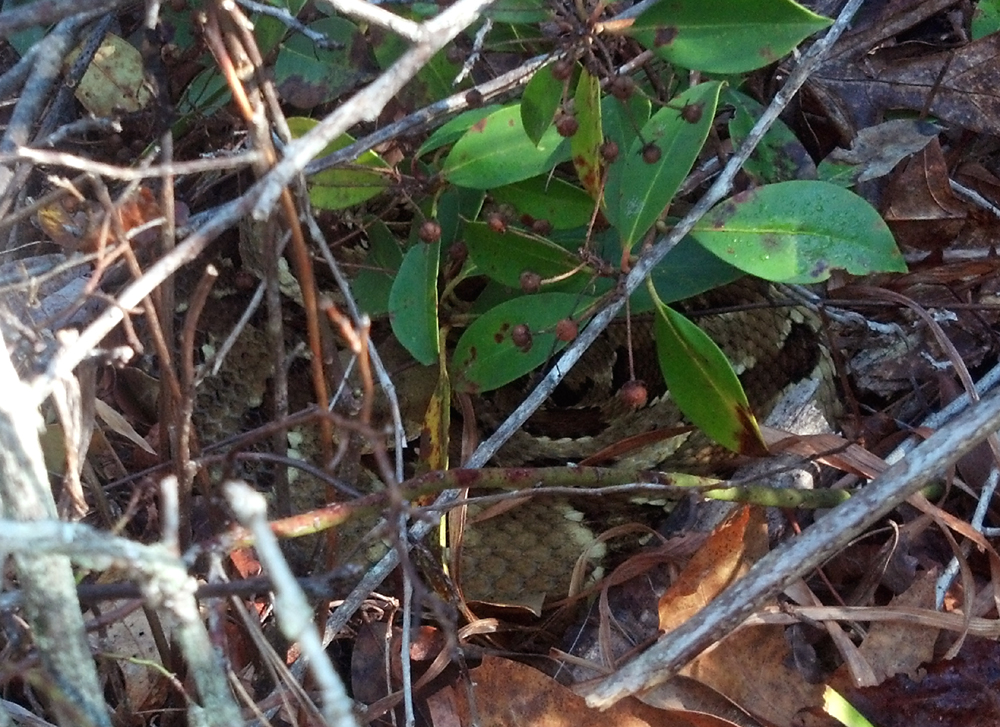
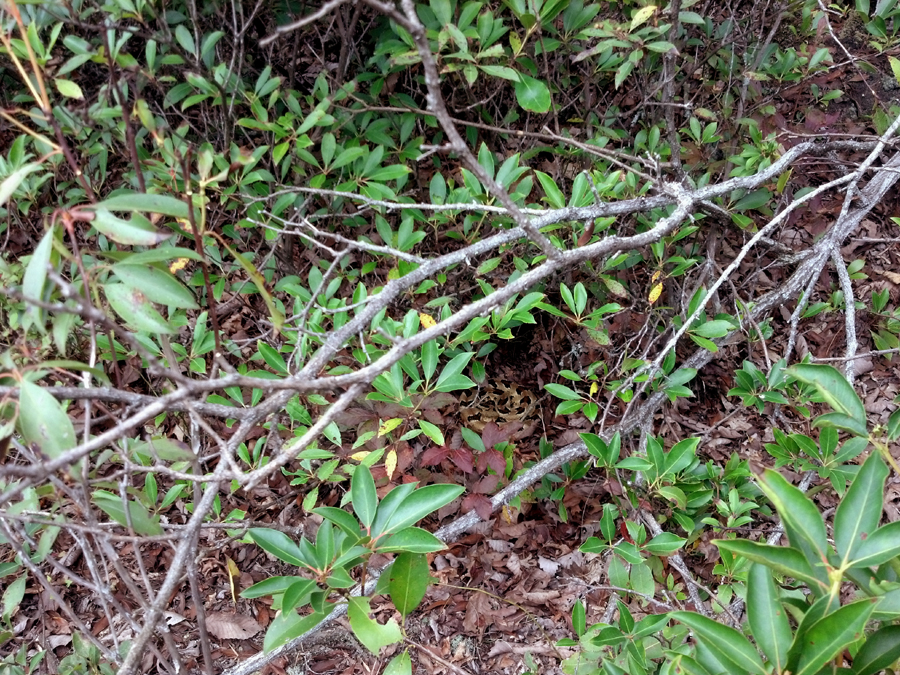
Both snakes never rattled or acted aggressive upon my approach–they just slowly moved a few feet away from me and hid when I started collecting my data. That’s a photo of Utsanati below–can you find him?
I am not paid to do this research–this is a volunteer project that I am undertaking to learn all that I can about these amazing animals to further educate you about their beauty, uniqueness and value to a healthy forest ecosystem. If you would like to support the Snake Tracks Timber Rattlesnake wildlife conservation, research, and education project and/or Earthshine Nature Programs please feel free to donate using this link. Receipts available upon request. You may also donate supplies such as animal foods, medical supplies, vitamins and habitat supplies. If you are interested in donating any of these items please contact us for more information on our current needs. THANK YOU to all of you who have donated to ENP!! Without you this important work would not happen.
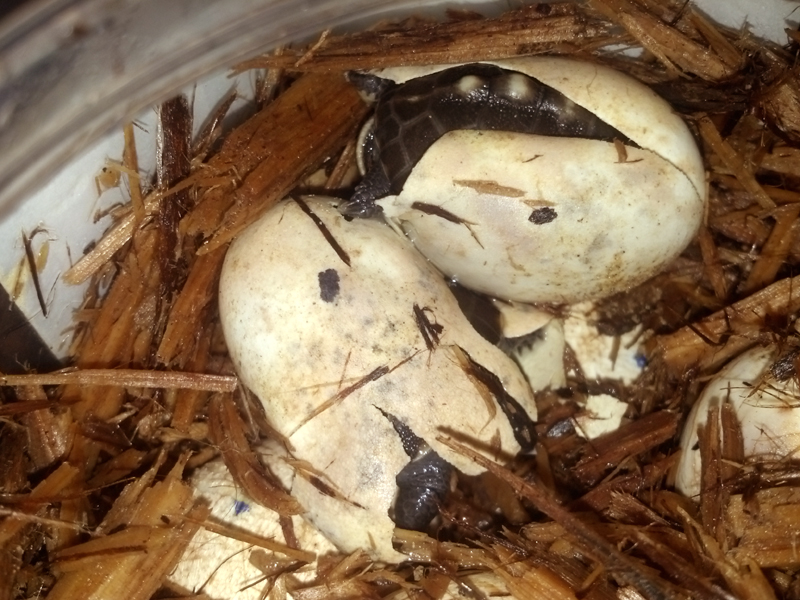
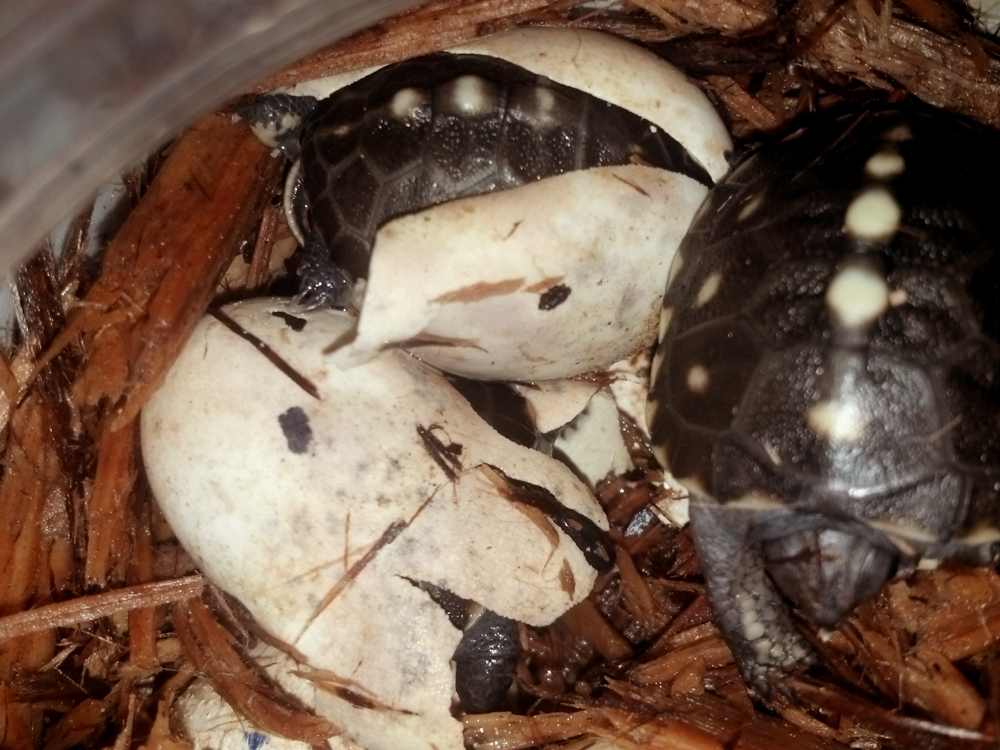
WOO HOO!! Two days ago I checked the incubator to find that the three Eastern box turtle eggs I have been incubating for the last month or so were hatching!! Take a look at the photos below of the little turtles hatching!
I received these little guys as eggs from a friend of mine who found them on a family member’s property. The property was being developed and unfortunately the eggs were dug up during the excavation. Fortunately for them the landowners cared about the welfare of wildlife so they quickly got the eggs to me so that I could try to incubate them and give them a chance at life. I placed them in an incubator with some ratsnake eggs that I am incubating and a few weeks later here they are!
While these little guys are really cute they are also really fragile and need special care. As you can see from the photos they are only the size of a quarter (that is a flash drive with the turtle below for size comparison).
Since they are so small they are eaten by many different forest animals such as Raccoons, Wild turkeys and other birds, Opossums, foxes, Chipmunks, snakes, and even your pet cats and dogs! Their chances of surviving to adulthood are very low if released in the same place so to help out with the odds I plan to release one of them near to where it originated and let it take its chances in the wild. I will release the second one in the protected forests at Earthshine (which is not very far from their home forest) and the third one I will raise in the box turtle head start enclosure in the nature center.
In a few years, when the head start turtle is old enough to protect itself, I will release it near its place of origin. Maybe I will be able to attach a tracking device to it’s shell and see how it does in the wild after being raised in captivity. Only time will tell.
This is an amazing story about an Eastern Box Turtle and the family that it has been a part of since 1930!
“Horace the 82 year old Turtle
By Bill M.
Date: 1930
Location: Astoria (Ravenswood) New York
My mom was 5 years old. My great grandfather brought home two young box turtles. I believe they were male and female. I have no idea how an Italian immigrant and family came up with the name Horace for the male. Unfortunately, I never asked. However my daughter did some research on line and came up with two possibilities.
1) There is a poet of Greek/Italian fame named Horace. However his real name is Quintus Horatius Flaccus born in Rome. My Great Grandparents came from Rome.
2) There was a Disney character from 1929 to 1932 called Horace Horsecollar. Horace was eventually replaced by Goofy. Disney has brought back the character throughout the years in movies and for greeting visitors at Disney World. However there wasn’t any TV in 1930. Maybe the movies or comics but my grandparents didn’t speak or read English that well.
The turtles were allowed to roam free in the yard and seek cover and hibernation under the plants. Around 1950 the female turtle either escaped or was assisted into a neighboring yard. The neighbor claimed ownership and refused to return the turtle. My grandmother didn’t speak to the neighbors for many years. My grandfather put up a better fence.
Horace, like most pets back then, ate what the family ate and anything else it enjoyed in the yard.
In 1990 with my great grandparents long deceased and my grandfather recently deceased, my grandmother decided to sell the house and move into an apartment in New Jersey near my aunt. Having no idea how fast the house would sell, my grandmother asked me to take Horace in June well before he would hibernate. I picked up Horace and his goodbye lunch (chicken parmigiana) and drove home to his new home in Valley Stream Long Island N Y. Not a great ride in 90 degrees without AC.
I built a PEN for Horace, initially it was a 1950’s-60’s 18” high corrugated metal pool frame (without liner). He had plenty of shade from plants and an upside down parsons table for a pond. He also had a Frisbee for a quick dip. I contacted the Tortoise and Turtle Society for information on turtle care. Their major concern was for Horace to be able to adapt to a new environment. Horace seemed happy in his PEN. I took him out at least twice a week and let him walk around the yard (under my watch). After a few times he would follow me around the yard and into the garage. I told friends and neighbors that my turtle was more obedient than their dogs. They were in awe as I demonstrated Horace following me.
Horace went into hibernation that fall and to our joy returned above ground in April. From that day on Horace became the weather prognosticator for my neighbors and colleagues at work. We knew to take in the lawn furniture once Horace went underground. The mild weather was over. For the last 5 years I have assisted him initially in digging the hole and softening the dirt (for his over-wintering spot). (Hey he is 82 years old!)
In 2002 with the assistance of my son-in-law we built a new 5’x 8’ PEN made of wood including the same plants and pool. Horace’s diet has been snails, slugs, eggs, dry cat food, watermelon, cantaloupe and his favorite Corn on the cob. It is amazing how he holds the cob with his front feet and nibbles it clean.
Unfortunately, in early July (2012) after returning from 5 days vacation, my wife noticed that Horace was spending an unusually long amount of time in his pool. I took him out of the PEN for a walk and immediately noticed he did not put out his right rear leg. Upon investigation, it was apparent that the leg was gone. We can only assume that a raccoon attacked him and he used the water to prevent bugs from entering his wound. We do have stray cats in the yard but never had a problem and they are fed well by my neighbor.
My wife went on-line and was able to contact Steve O’Neil who gave us some advice on treating Horace for that evening until we were able to take him to a VET. Long story short, the foot was gone and the skin/tissue from the ankle to the knee was torn apart. The Vet amputated the leg up to the knee and sutured the wound closed. We had to bring Horace to the Vet every other day to complete 5 shots of antibiotics. The first 2 weeks after the operation we kept Horace in the rabbit cage (in the garage at night and outside during the day). We had a few obstacles since the operation (maggots in the wound) but as of now Horace is living in our house in a transparent file box (half the time filled with water up to the shell opening) to flush out or notice any foreign bugs (flies) that may enter the wound. We have now completed 2 weeks of Horace living in the house and he is now spending about 8 hours a day in the water. We put him in a rabbit cage for exercise and feeding and hope that he discharges his waste when he is in water.
We must bring Horace back to the Vet in a week to determine if he can be put back in the PEN. My son in law and younger daughter built a top for the pen using wood and 19-gauge wire screen. I hope the VET allows Horace to go back in the PEN soon. This time of year the days are still very warm and the evenings are cool. It is perfect weather to see if he starts to dig. (Naturally I will start the hole and make the soil extra soft) If all goes well and he hibernates I will add multiple layers of leaves and mulch over his hole.
If Horace is not able to hibernate, I will have a problem. Per Steve and others, a non-hibernating turtle needs a certain temperature range and daily care. I do not have the ability to provide the temp nor the daily care. We neither have a basement nor an attached garage. Also there isn’t any guarantee that he can take the stress of non-hibernation.
We love our turtle and want to give Horace the best chance of survival. No one can give any guarantees.
If we are allowed to put Horace back in the PEN, I will feel some comfort if he starts to dig. Then it is up to God. If he is not able to go in the PEN, I will sadly look for someone to adopt and care for him.
God willing we will write a happy follow-up in the spring of 2013.”
What a great story! Further proof that the Eastern Box Turtle is a very hearty and long lived creature that, if given the correct environment and life requirements, can thrive and outlive we Humans. Horace is a lucky turtle to have lived with such a caring family for over 80 years. I would like to point out that Horace is probably closer to 90 years old because when they brought him home he was already a few years old. Amazing! He doesn’t look a day over 25.
If you have a pet box turtle then you need to be aware that it may be with you for decades and you may even need to arrange care for it in your will.
The next time you find a box turtle in the forest or fields just think about Horace and how good he looks. The turtle you find may be 25 or 125! Remember that that turtle has been following the same movement patterns for all of his life and if you move him or take him home he will have a very hard time adjusting to the change. Please leave turtles where you find them–they will thank you for it. If you find a turtle crossing a road it is not lost or in need of rescue or re-location. It knows where it is going and when it needs to get there. It has an agenda. All you need to do is gently pick it up and move it to the side of the road that it is moving toward then place it a few yards off of the road in some cover and leave it alone.
Watch this short video of Horace!
Today I discovered Zoe stretched out on the leaf litter–she was on the move heading north possibly toward her hibernation location.
I found her only around 100 feet from the woodpile where Utsanati has spent lots of time over the last year! This means that she has moved over 1/2 mile over the last two weeks and successfully evaded the heavy equipment on the south side of the ridge. Because I find these snakes in the vicinity of the woodpile in the early spring and again in the late summer it makes me wonder if these snakes use this ridge line as sort of a highway when moving from feeding to wintering grounds–only time will tell.
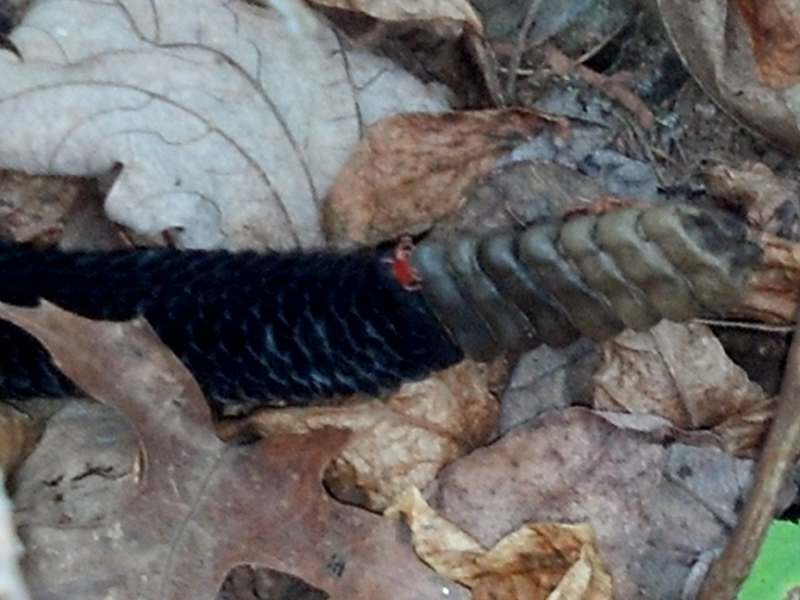
Zoe had a hitchhiking red mite at the base of her rattle. I do not know it it was simply getting a lift or if it was actually feeding on Zoe. Here’s a photo.
When I approached Zoe her she was calm, quiet and never rattled and barely even moved so I decided to test her comfort zone and see what it would take to get her to rattle without touching her–boy was I in for a surprise! I could explain what happened in a very long paragraph but the best way for you to experience it is to watch the video below.
Here is a photo from just after I shot the video…
Watch the video to find out way Zoe is coiled so close to my foot!
If the video does not show up just follow this link.
I am still processing this amazing experience but I will tell you that this encounter has further strengthened my belief that Timber Rattlesnakes are timid, secretive, docile and non-threatening–unless you harass them or harm them. Then they can be dangerous and will use their venom in self defense and I can not blame them for that because I would do the same if I was in their shoes…er, scales.
Zoe was very close to human inhabited areas on September 14th so if you live near the woodpile I mentioned please be on the look out for her. I plan to re-locate her on the 20th and will report on her then.
I found Utsanati sheltering in the remote forest at the edge of the power line access way far from human habitation and activity areas.
When I found him he was in a resting coil under a Mountain Laurel shrub. He never rattled or moved.
What a beautiful creature!
I am not paid to do this research–this is a volunteer project that I am undertaking to learn all that I can about these amazing animals to further educate you about their beauty, uniqueness and value to a healthy forest ecosystem. If you would like to support the Snake Tracks Timber Rattlesnake wildlife conservation, research, and education project and/or Earthshine Nature Programs please feel free to donate using this link. Receipts available upon request. THANK YOU to all of you who have donated to ENP!! Without you this important work would not happen.
Meet Crash, our new Education Opossum! The details are in the video:-)
I have set up a live “Possum Cam” in Crash’s enclosure. Feel free to view Crash anytime you like by following this link. Crash is usually active in the morning and evening (the camera has IR lighting!) and after feedings. Good luck seeing him! If you are using Internet Explorer the login is “visitor” and the password is “possum”. (both without the quotes)
If you are using any of the other listed browsers (firefox, chrome etc…) just click the login button under Server Push Mode and enter the login “visitor” and the password is “possum”. (both without the quotes)
Click LIVE VIDEO to see if Crash is out and about. Feel free to take control of the camera and pan/tilt to look around Crash’s habitat.
If the camera seems slow it may be that other people are viewing the camera slowing it down.
Special thanks to Saya for helping me introduce Crash to you all.
Special thanks to Jenny for operating the video camera.
Earthshine Nature Programs is a non-profit organization (501c3) dedicated to the conservation of the more misunderstood creatures here in our corner of the world. We provide education, conservation and outreach programs and strive to educate you about the truth of our amazing wildlife and natural world around us.











 Earthshine Nature