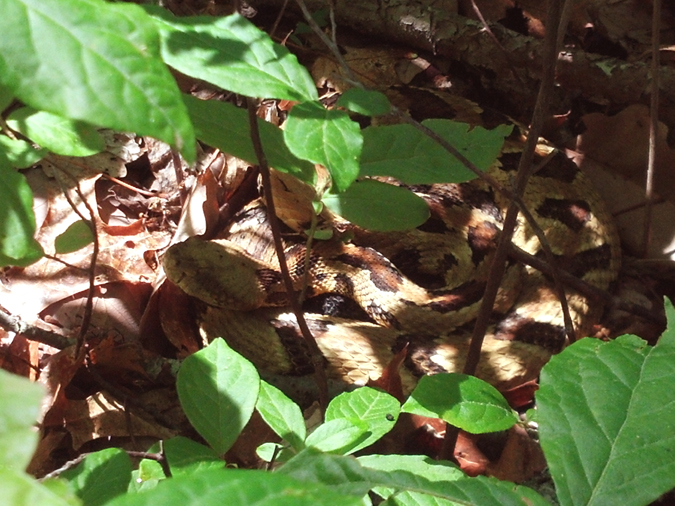
A Visit to a Timber Rattlesnake Den

A few days ago I teamed up with some wildlife conservation friends and we ventured deep into a remote forest in the search of a Timber Rattlesnake den site.

The day started early and after a lengthy drive over rough and rutted roads (thank goodness for 4wd) we came to a remote pull off on the side of a long forgotten trail deep in the forest.  We geared up and headed off to shoot some rattlers–with cameras!  After a grueling hike up a steep mountainside covered in ripening blueberries we came to what looked like an impassible Rhododendron thicket…we dove in and picked our way through for at least a hour before we were rewarded on the other side by a view of a sprawling mountain bald laid out before our eyes.  It was a beautiful and somewhat surreal place, a fragile habitat that called for us to walk gingerly so we would not destroy the fragile mosses and lichens that grow like fairy gardens from the rocks.  Alan, our guide, pointed out a rock where he had seen several rattlers a few days before so we used our cameras to zoom in and search the area for occupants–and there they were, three large Timber Rattlesnakes basking in the morning sun!  They were beautiful snakes and they remained calm and still until we approached closer–then they began to rattle and slowly moved under the nearby rock to shelter from the huge creatures that had disturbed their morning basking ritual.  We laid down on the warm bald and used our cameras to zoom in and get some video and photos of these beautiful creatures (see video below).  Alan then noticed two rather plump Northern Copperheads sharing space under the rock with the rattlers–we took more pictures.

After we had our fill of the first rock Alan led us across the bald to another rock where we found a pile of rattlesnakes!  There were four in all and they were basking together in the warm morning sunshine.  Upon our approach they began to rattle and then they  moved quickly under their shelter rock to escape the invaders. We approached the rock and again flattened ourselves on the bedrock of the mountain to observe these beautiful and misunderstood creatures.  Several of them continued to rattle for a time until they felt content that we were not going to proceed any farther and harm them–then they calmed down and stopped rattling and let us take some more photos.

Nearby I found what looked to us like a possible den entrance hole and a shed timber rattlesnake skin.

We discussed the fact that so many chunky, healthy rattlers–7 in all–were basking together on this one small rocky bald.  We came up with the hypothesis that all of these snakes may be females and that this site may be a maternity/gestation site!  Female Timber Rattlesnakes and Northern Copperheads are live bearers–they do not lay eggs.  When they are gravid (pregnant) they move to a site that provides warmth in which to raise their body temperature and speed up gestation of the baby rattlers inside of them, shelter in the form of rocks to hide under and safety–these sites are usually far away from areas that humans frequent.  Not because the Timber rattlesnakes chooses these remote sites to be away from humans but because the other rattler maternity/den sites that were once in the areas where humans now range–have sadly all been destroyed by people that are fearful of snakes.

After surveying the remainder of the site for more rattlers and not finding any we decided to leave the site so not to further disturb these beautiful and sensitive creatures.  We have also decided to not return to the site any more than necessary so we limit the risk of stress to the snakes in this crucial time in their lives.  We may return in the late summer to see if the mothers have had their young and if we do I will be sure to report on it.

For the full story as it happened on film take a look at the video of our visit to a Timber Rattlesnake den.

The Timber Rattlesnake is vanishing from many parts of its range for many reasons:

Rattlesnakes are often killed on sight just because they are snakes.

Rattlesnakes are often collected from the wild for horrible rattlesnake roundups where they are tortured and killed and their arts are then sold for the production of boots, bags and belts and other rattlesnake trinkets and for their meager amount of meat.  These rattlesnake products are often used by people who believe that owning or eating a part of a rattlesnake will make them more desirable in some way.  In truth it makes them less desirable in all ways because they are supporting the continued killing of a beautiful, shy and unique creature that deserves to live.  Please do all you can to stop rattlesnake roundups.

Rattlesnakes are often kept as “pets” by people who like to keep snakes.   This is illegal in many areas without specialized state and possibly federally issued permits.

Rattlesnakes are often illegally sold to people in Asian countries for medicinal and fertility concoctions that do not work.

Because of the human persecution of Rattlesnakes–they are now extirpated (locally extinct) in many areas where they once ranged.

Many of these areas have now enacted protection for the rattlesnake.  In North Carolina it is illegal to collect, capture, possess or harm a rattlesnake unless it is threatening your life.  This means you cannot touch, harm or capture a rattlesnake if you see it in the forest while hiking/hunting/camping and so on.  The forest is the snakes home–not yours.  If the snake is in your kitchen or your child’s play area then that is a different story.  The snake has a role to play in the circle of life and it deserves to live just as much as we do.  If you are privileged and lucky enough to one day cross paths with a rattlesnake–stop.  Back up and marvel at this wonderful and beautiful creature that you have found.  Take out your camera and get some photos–from a safe distance of course.  Please do not harm the snake.  Please let it live and grow and play the part in nature that it is meant to play–the role of a very effective predator of rodents and food source for other creatures.

The fact is that many, many more rattlesnakes have been killed by people than people have been killed by rattlesnakes.  Less than 20 people per year die from the bite of venomous snakes in the USA.  How many people are killed by other people–it looks like we humans are FAR more dangerous than the rattlesnake will ever be.

For more on Earthshine Nature Programs please visit: Earthshine Nature Programs
Rattlesnake Report for 5/28/12

Today when i went to look for Zoe I was unable to get a signal in any direction. I walked deeper into the forest and still no signal. I drove to the end of the road–no signal. I began to think she had either moved out of range or been carried off by a predator such as a hawk or owl. i decided to search for Utsanati’s signal to see if he had moved closer to Zoe and when I input his frequency into the receiver his signal was as if he was sitting right next to me! I panned the antenna around just to be sure and yes–he was right in front of me in the very same woodpile that he visited in the late summer of 2011. He had come back to the woodpile for what purpose–rodents, thermoregulation, shelter–or all of the above. Whatever the purpose I quickly got some video and data and left him alone in all his glory. I am amazed that in one week he has moved so far. He trekked from the top of the mountain above Earthshine to the woodpile–moving most likely along the edge of the forest as he did last year after his transmitter implantation surgery. The movements of Timber rattlesnakes will never cease to amaze me. Due to Utsanati’s presence in the woodpile his danger level is a 5. If you live in the area of the woodpile please use caution when walking/working near brush and thick vegetation especially from dusk to dawn when Timber rattlesnakes are most active.

I had found Utsanati but where was Zoe? I drove to the top of the mountain above the lodge to try to get to the highest point to search for Zoe’s signal–no signal. I drove down the trail in the woods below where she was previously located–no signal. I decided to slowly drive around the side of the mountain where she had last been located and venture up every road and driveway until I found her signal…it worked! The third trail I went up went through a field of tall grass and near the end of the field I picked up her signal quite strongly! I drove down a rough trail and through an overgrown field to where the road ran out near the edge of the forest. When I exited the vehicle I could hear a waterfall somewhere nearby. I searched the thick bushes and followed her signal to an area of overgrown vines, wild rose and blackberry brambles where I found her resting in a coil in the warm sun under some tall grass. She had ants biting at her and was twitching the get them to leave her alone. I also noticed that she had an injury or dry skin spot on her left side a few inches back from her head. Maybe she had encountered a predator in her travels? I was unable to investigate it farther because she moved off into the tangle of vines in response to my presence and the ants. She had traveled over 1/2 a mile in one week! She had passed through very hazardous terrain for a rattlesnake–farms, roads, trails, predators, dogs and humans were all obstacles in her way–but somehow she managed to survive. Where is she going? Only time will tell.

Watch the video of my search today for Utsanati and Zoe.

The release of Lucky Longnecker and a fun Watersnake Encounter

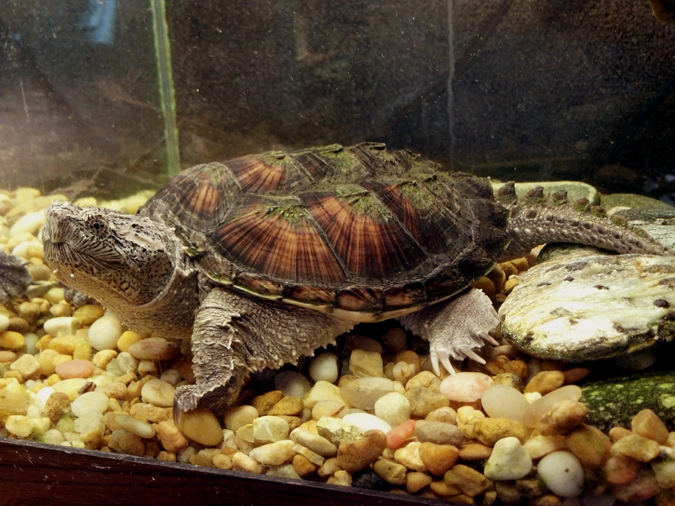
Lucky Longnecker–a juvenile Common Snapping Turtle–came to us in May of 2010.  Our maintenance guru Gene found him in the parking lot on a hot spring day.  What he was doing that far from water we will never know–but he appeared dead and dessicated.  I gave him a soak in a warm water and over the next few hours he came back from the brink of death.  We have had him ever since in a 20 gallon aquarium in the Nature Center where he has grown by leaps and bounds into the strong and healthy sub-adult snapping turtle we all know and love.  This is the most recent photo of Lucky below.

Lucky has grown to large for his enclosure so on 5-20-12 we decided to release him into the pond where he was probably born 3-4 years ago.  Before we released him we filed a couple of tiny notches on the trailing edge of his carapace so that we can always identify him if we ever see him again.  Watch the video below to view the release of Lucky and then watch as we then discover a medium sized Northern watersnake and I catch it for everyone to meet and learn about!

Rattlesnake Report for 5-20-12

Zoe has moved around 60 feet south of her previous location beside the trail.  I found her coiled in a resting coil about 6 inches from an 8 inch diameter oak log.  About 10 feet uphill from and resting beside the same log as Zoe I spotted a small Copperhead coiled on the surface–the hunting must be grand in this area.  Zoe is far enough from the trail that I can lower her danger level to a 3 but not far enough to make it a 1 because she could easily move back uphill to the trail.

Utsanati remains on top of the ridge where he has been for the last couple of weeks.  His danger level is a 2.

View the video below for the action from the field!

This report was made from the field using my Droid.

FREE PAUL WATSON

One of my heroes–Paul Watson, the founder and leader of the aggressive and highly effective marine conservation group “Sea Shepherd” – known mainly for disrupting whale hunts, documented on the reality TV program “Whale Wars” – has been detained in Germany at the request of Costa Rica, which wants him extradited on trumped up charges from shark fin poachers and whale killers. I strongly support Sea Shepherd and their past actions to protect marine life and I look forward to their  forthcoming “global campaign to save sharks from extinction”.   Love him or hate him Paul Watson is making a difference in the way people view the animals of our oceans.  Please do all you can to help get Capt. Watson released from jail and back at the helm of the Steve Irwin protecting the seas from man.


I also feel that I must say that while I have been to Costa Rica and find it to be a beautiful country with wonderful people–I cannot continue to support their tourism industry when they support shark finning –especially when it is in their own designated marine preserves like Cocos Island.  If you are planning a trip to visit Costa Rica–please reconsider.  If you stop supporting them with your tourist dollars then they will hopefully get the message and work to end illegal shark finning in their waters. If you did not know or do not believe that Costa Rica is shark finning then please watch the documentary Sharkwater  —   It changed the way I view sharks and our impacts on the oceans.  It changed my life.  Paul Watson has changed my life and made me more of an activist for the change that is needed in this world.

I have also included several links where you can learn more and sign petitions to help free Capt. Watson.

http://www.seashepherd.org/index.php

Visit FreePaulWatson on facebook at: http://www.facebook.com/FreePaulWatson

http://www.ecoearth.info/shared/alerts/sendsm.aspx?id=shark_finning

http://www.thepetitionsite.com/663/009/291/release-paul-watson/

http://redhotchilipeppers.com/news/340-red-hot-chili-peppers-call-for-german-authorities-to-stop-extradition-of-sea-shepherd-captain-paul-watson-to-costa-rica


Please support Sea Shepherd in their fight to protect the oceans from man and out destructive ways.

LOST TURTLE ALERT

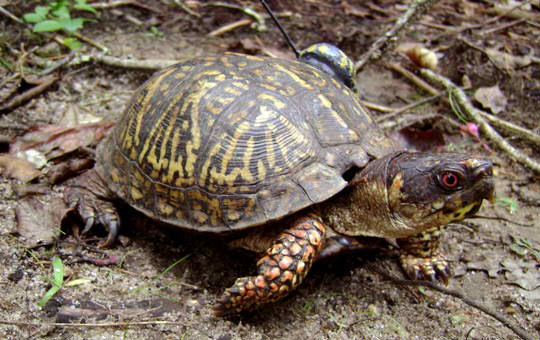
Mr. Bones is an Eastern Box Turtle that lives in the forests and fields in Cedar Mountain, NC.  Since 2007 he has been part of the TURTLE TRACKS wildlife conservation study using radio telemetry to learn more about the natural movements of wild box turtles.  In 2010 his transmitter (the object attached to his shell on his left side) failed and we lost track of him.

If you live in Cedar Mountain you can help us find Mr. Bones by keeping your eyes open for box turtles crossing the road in front of the Creekside Market on the south side of 276.  Also keep your eyes open for road crossing turtles for about 1 mile up and down 276 on either side of the Creekside Market.  If you find a box turtle in this area–with or without a transmitter attached to it’s shell–please pick up the turtle (they do not bite),  place it in a tall bucket or box, note exactly where you found the turtle and if possible, the direction it was moving.

Then call the Turtle Tracks project coordinator Steve O’Neil at 828-606-8939.  If you are unable to reach Steve and/or if the turtle is injured please call Steve’s intern Elisha Ely at 724-991-7893 so that one of us can pick up the turtle and if it is Mr. Bones attach a fresh new transmitter and release him back into the forest so that we can continue tracking his movements.  If it is not Mr.Bones or Mrs. Bones the female that we are tracking–finding new turtles is always a great thing because it furthers our knowledge of the Eastern box turtle in the Cedar Mountain area.

Box turtles are most active during the mornings and later in the day and especially during and after rain showers so please drive carefully during these times.

Thank you for you help finding the lost Mr. Bones.

For more information on the Turtle Tracks project take a look at our website at: www.earthshinenature.com

Box turtles are in danger when they cross roads.  No matter where you are,  if you find road crossing box turtles please pick them up and move them to the side of the road that they are moving toward then place them a few yards off of the road in the cover of the forest/bushes.  This greatly improves their chances of survival and you get extra credit for doing a good deed and helping an animal in need.